

The State of Mobile Game Advertising in 2026: Channels, Creatives & Genre Insights


As 2026 unfolds, the global mobile game advertising market is undergoing another round of strategic adjustments. With competition in the mobile gaming industry intensifying, advertisers are no longer competing for users through ad spend alone. Media channels, ad formats, creative assets, and audience targeting are increasingly working together to determine user acquisition (UA) efficiency.
According to Sensor Tower, the overall structure of mobile game advertising spend remained relatively stable in 2026, while social media channels regained momentum. Channel preferences continued to diverge across game genres, and leading advertisers significantly accelerated their creative production and testing cycles.
These developments raise several important questions: Which channels are attracting the largest share of global mobile game advertising budgets? How do UA strategies differ across game genres and regions? This article explores these trends through Sensor Tower data, examining the market landscape, genre and regional differences, and channel strategies.
Ⅰ. Display Advertising Remains the Core
The global mobile game advertising market showed a relatively stable overall structure in 2026, accompanied by some notable shifts across individual channels. Display advertising remained the primary advertising format for mobile game advertisers, while social media emerged as a key driver of changes in the channel mix.
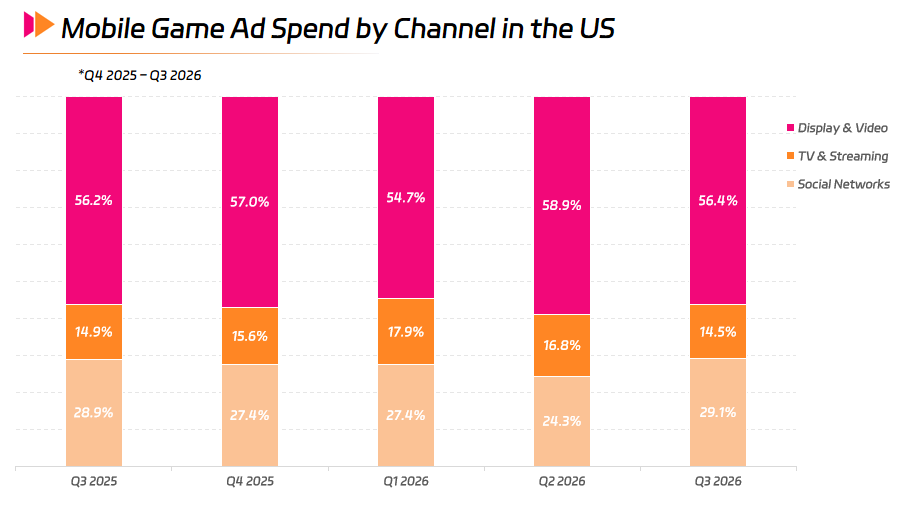
According to Sensor Tower, from Q3 2025 to Q3 2026, Display & Video consistently accounted for 55% to 59% of global mobile game advertising spend. In Q3 2026, its share reached 56.4%, reaffirming its position as the market's leading advertising channel.
Source: Sensor Tower
Social Networks, meanwhile, experienced more noticeable fluctuations. Their share of advertising spend dropped to 24.3% in Q2 2026 before rebounding to 29.1% in Q3. Over the same period, TV & Streaming declined from 17.9% in Q1 2026 to 14.5% in Q3.
These figures highlight the complementary roles of different channels. Display advertising continues to support large-scale audience reach, while social media and TV & Streaming provide additional opportunities for advertisers to engage potential players across different touchpoints.
Source: Sensor Tower
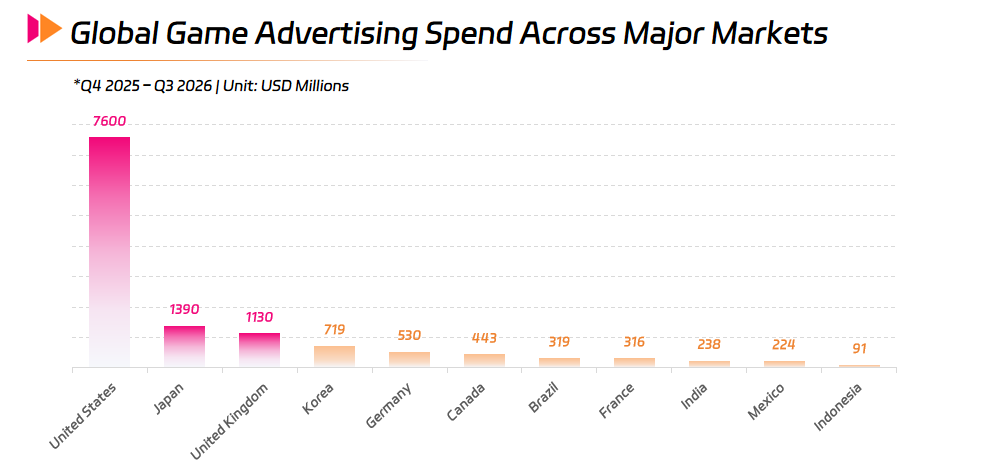
Geographically, global mobile game advertising spend remains highly concentrated. The United States alone accounts for nearly 60% of the total, with its advertising budget exceeding the combined spend of all other markets. Japan and the United Kingdom rank second and third, respectively. Together, these three markets represent nearly 80% of global UA spending, making them key destinations for advertisers targeting mature markets with high lifetime value (LTV) players.
Markets in the middle and lower tiers show a clear divide between established markets and emerging opportunities. South Korea and Germany maintain solid positions thanks to their high-spending player bases, while Canada, Brazil, France, India, Mexico, and Indonesia account for comparatively smaller shares of advertising spend.
Source: Sensor Tower
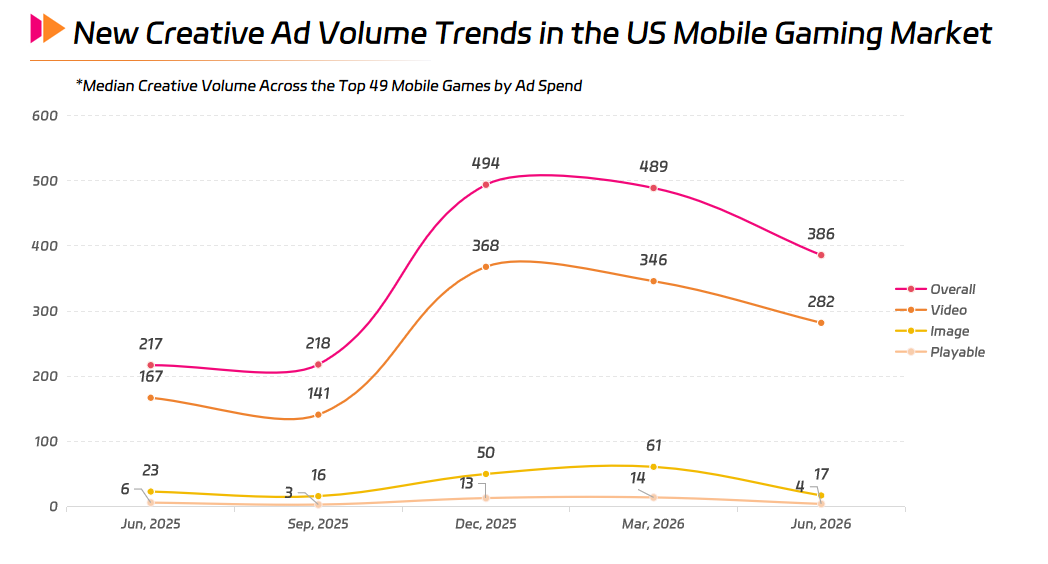
Creative production and testing among leading advertisers have also become increasingly active. From June to September 2025, the average monthly number of new creatives remained relatively stable at around 217. By December 2025, this figure had surged to 494 and remained elevated in March 2026. Although it declined to 386 in June 2026, it was still significantly higher than the levels recorded in the first half of 2025.
In terms of creative formats, video remains the primary format in mobile game advertising, while image and playable ads account for smaller shares and show greater fluctuations. In March 2026, the number of image and playable creatives reached 61 and 14, respectively, before falling to 17 and 4 in June.
NetMarvel's Insights: As leading mobile game advertisers continue to increase their monthly creative output, maintaining a consistent supply of fresh assets and improving production efficiency have become increasingly important. Video remains the dominant creative format, with image and playable ads serving as complementary options. Advertisers should continuously develop creatives around core gameplay mechanics and key product selling points. By leveraging generative AI (AIGC), they can accelerate creative production and iteration, diversify their asset portfolios, and quickly phase out underperforming creatives based on campaign performance to combat creative fatigue.
Ⅱ. Game Genre Determines Media Buying Strategies
Different game genres have distinct audience profiles, gameplay mechanics, and conversion paths. As a result, advertisers' media channel preferences vary considerably across categories.
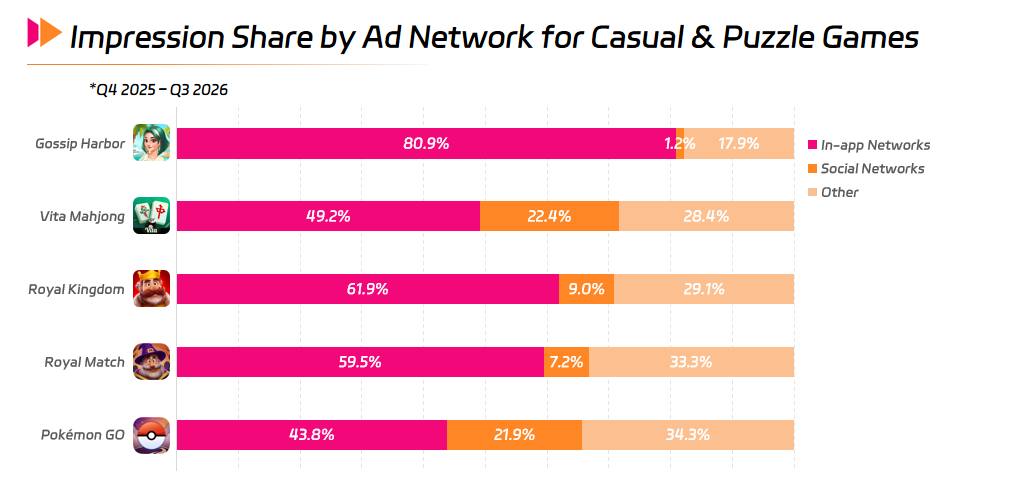
Casual puzzle and merge games, for example, typically prioritize scalable user acquisition, making in-app advertising networks an important source of traffic. In the US market, 81% of ad impressions for Gossip Harbor came from in-app networks. In-app networks also accounted for the majority of impressions for Vita Mahjong, Royal Kingdom, and Royal Match.
Source: Sensor Tower
These campaigns typically leverage formats such as rewarded video and playable ads to reach potential users within other casual gaming environments. This approach helps advertisers generate incremental traffic through frequent exposure to relevant audiences.
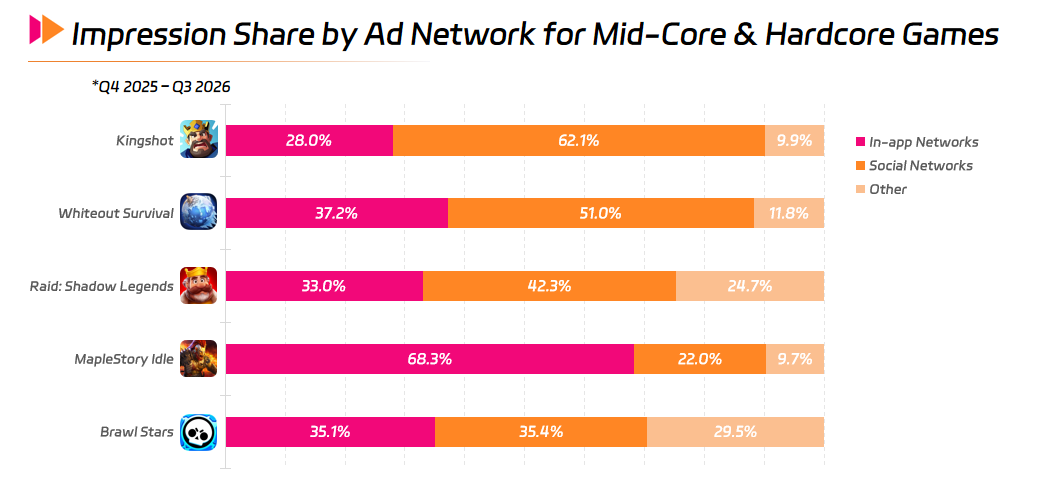
Strategy and 4X SLG games, on the other hand, tend to rely more heavily on social media and video advertising. Social media accounted for 62% of ad impressions for Kingshot, compared with 51% for Whiteout Survival and 42% for Raid: Shadow Legends.
Source: Sensor Tower
This reflects the nature of strategy games, which often require more detailed demonstrations of gameplay mechanics, progression systems, and narrative elements to communicate the core player experience. Video advertising is particularly effective at delivering these more complex messages and helping potential players understand what a game has to offer.
However, game genre is not the only factor determining channel selection. MapleStory Idle, for example, belongs to the mid-core gaming category, yet in-app networks account for 68% of its ad impressions. This suggests that established products often adopt channel strategies shaped by a combination of audience demographics, product lifecycle stages, and accumulated UA experience.
NetMarvel's Insights: In practice, advertisers should incorporate both in-app advertising networks and social media networks into a unified media budget strategy. Budget allocation should be adjusted dynamically based on acquisition costs, user quality, and downstream conversion performance across channels. Meanwhile, testing multiple traffic sources can reduce reliance on any single channel and help advertisers strike a better balance between acquisition scale and user quality.
Ⅲ. Conclusion
Overall, the global mobile game advertising market in 2026 is characterized by shifts in channel allocation, increasingly differentiated UA strategies across game genres, and faster creative iteration. Display advertising remains a key foundation for scalable user acquisition, while social media continues to unlock new growth opportunities. Meanwhile, differences in audience behavior and traffic characteristics across game genres and regional markets are further shaping advertisers' channel decisions.
For mobile game advertisers expanding into international markets, UA competition is no longer simply about advertising budgets or traffic volume. It is increasingly a comprehensive challenge involving channel alignment, regional market insights, and creative efficiency.
By aligning UA strategies with product positioning and target market characteristics, and continuously optimizing channel mixes, creative strategies, and campaign execution, advertisers can achieve more efficient user acquisition and sustainable growth in an increasingly competitive global market.