

September Global AI App Market Insights: General AI Assistants Lead, AI Agents Grow


In September, growth across the global AI app market became increasingly uneven. General-purpose AI assistants continued to dominate, with leading products further strengthening their user base advantages. Meanwhile, AI agent apps attracted growing attention. New launches such as Meta's Muse recorded rapid growth, introducing new momentum into the market.
By contrast, several vertical categories, including AI social companionship, music and voice, and image generation, faced declines in monthly active users (MAU), highlighting increasingly divergent growth patterns across the market.
In this edition, we examine September's global AI app market through three dimensions: overall market performance, category-level trends, and leading apps. By tracking MAU changes and product growth, we explore the evolving competitive landscape and emerging directions in the global AI app market.
1. General-Purpose AI Assistants Dominate the Market
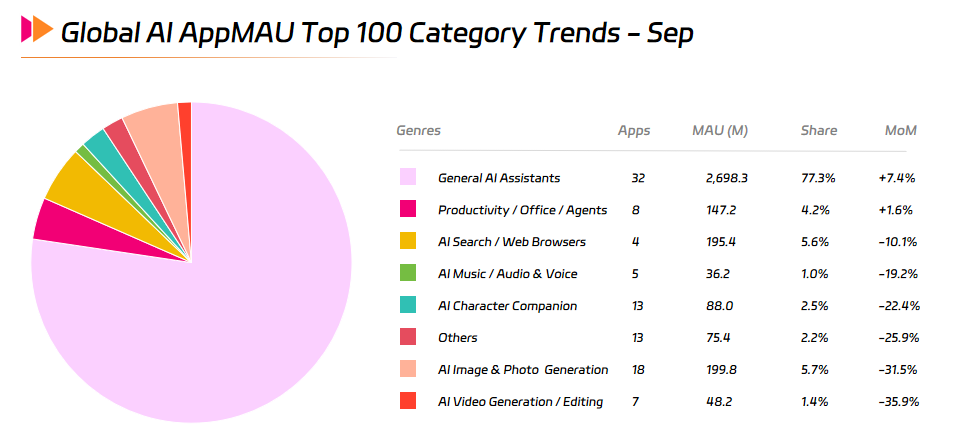
Among the top 100 global AI apps, general-purpose AI assistants and chatbots accounted for 32 apps in September, with combined MAU reaching 2.69 billion. This represented 77.3% of the total and month-over-month growth of 7.4%. The category maintained a clear lead in both the number of apps and user scale.
Productivity and office tools, AI agent apps, and cloud storage apps accounted for eight apps, with combined MAU of 140 million, up 1.6% month over month. AI search and browser apps reached 190 million MAU, but declined 10.1%.
Several vertical categories experienced more pronounced drops in activity. MAU for AI music and voice, AI character companionship and social chat, and AI image generation and photo editing fell 19.2%, 22.4%, and 31.5%, respectively. AI video generation and editing saw an even steeper decline of 35.9%, pointing to mounting user retention challenges.
For vertical AI apps, offering AI-powered features alone may no longer be enough to sustain growth. Integrating into specific workflows and building lasting usage habits will be increasingly important for retention and long-term expansion.
Source: aicpb.com
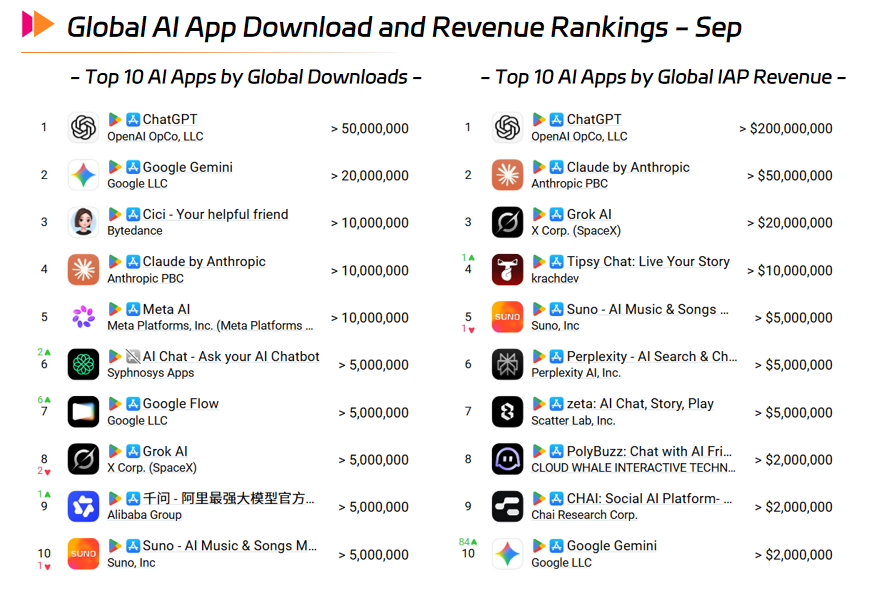
Looking at individual apps, ChatGPT topped the global AI app download rankings in September with more than 50 million downloads. Gemini exceeded 20 million, while Cici, Claude, and Meta AI each surpassed 10 million. AI assistants continue to attract new users, supported by strong brand recognition and product capabilities that give leading apps a competitive advantage in user acquisition.
Paid revenue was even more concentrated among top apps. ChatGPT generated more than $200 million in global in-app purchase (IAP) revenue, followed by Claude with over $50 million and Grok with more than $20 million.
Source: AppMagic
2. Overall MAU Remains Relatively Stable, but Growth Diverges
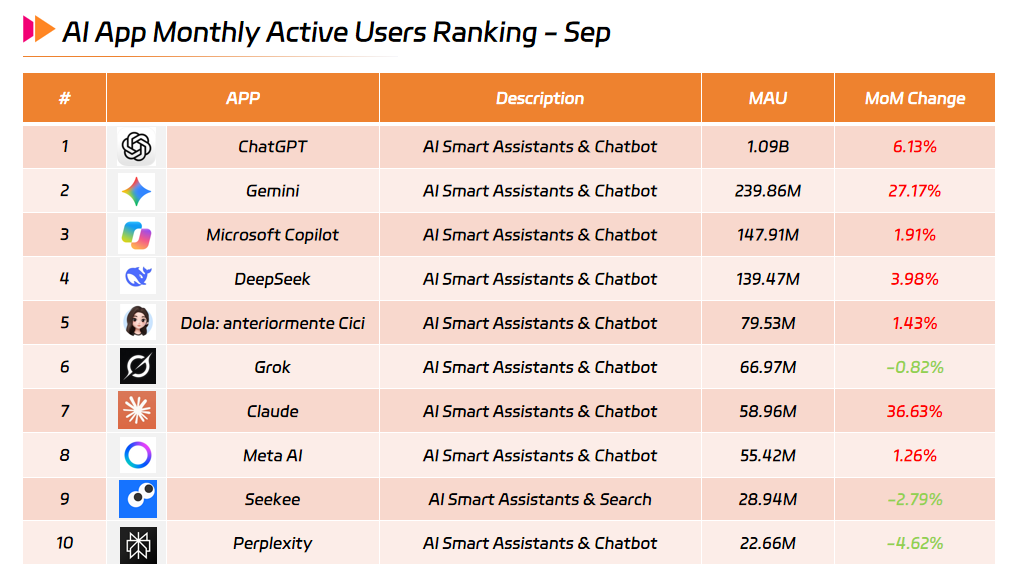
At the individual app level, ChatGPT remained the clear leader with 1.09 billion MAU, far ahead of other products. Gemini ranked second with 230 million MAU, while Claude recorded the fastest MAU growth among the top 10 apps, approaching 60 million users.
Meanwhile, MAU for Grok, Seekee, and Perplexity declined by 0.82%, 2.79%, and 4.62% month over month, respectively. Growth among leading AI apps is becoming increasingly uneven, indicating that the competitive landscape remains fluid and far from settled.
Source: aicpb.com
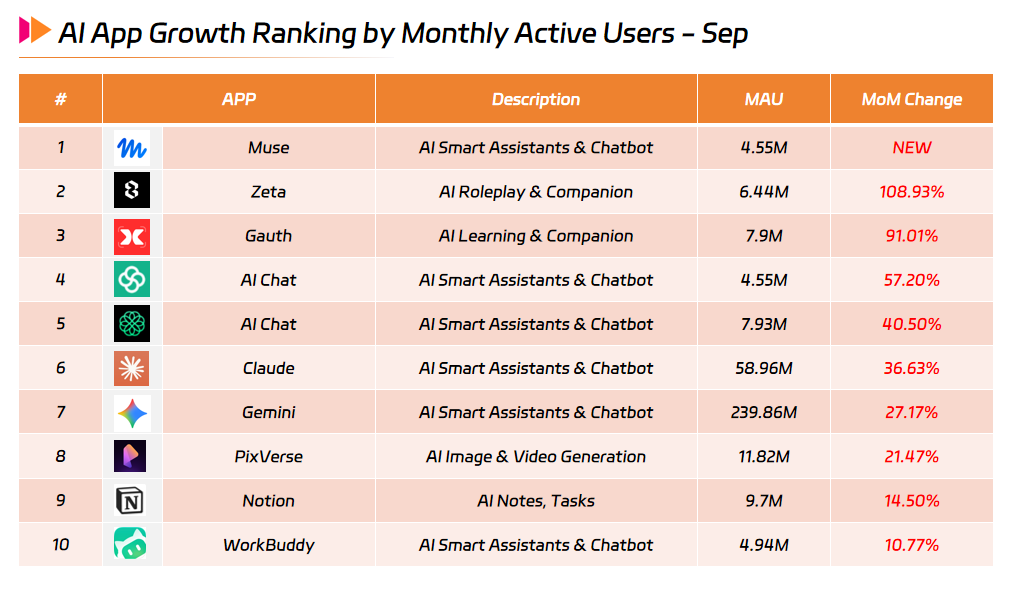
September's growth rankings revealed even sharper differences across categories.
On one hand, breakout products fueled strong growth in AI assistants and AI agents. Meta's newly launched AI agent Muse entered the rankings for the first time, reaching 4.55 million MAU. Claude and Gemini also performed strongly, growing 36.6% and 27.1% month over month, respectively.
On the other hand, leading apps in vertical categories continued to attract a disproportionate share of user attention. AI social companionship app Zeta nearly doubled its MAU, rising 108.9% month over month. AI education app Gauth followed closely, growing 91.0%.
Source: aicpb.com
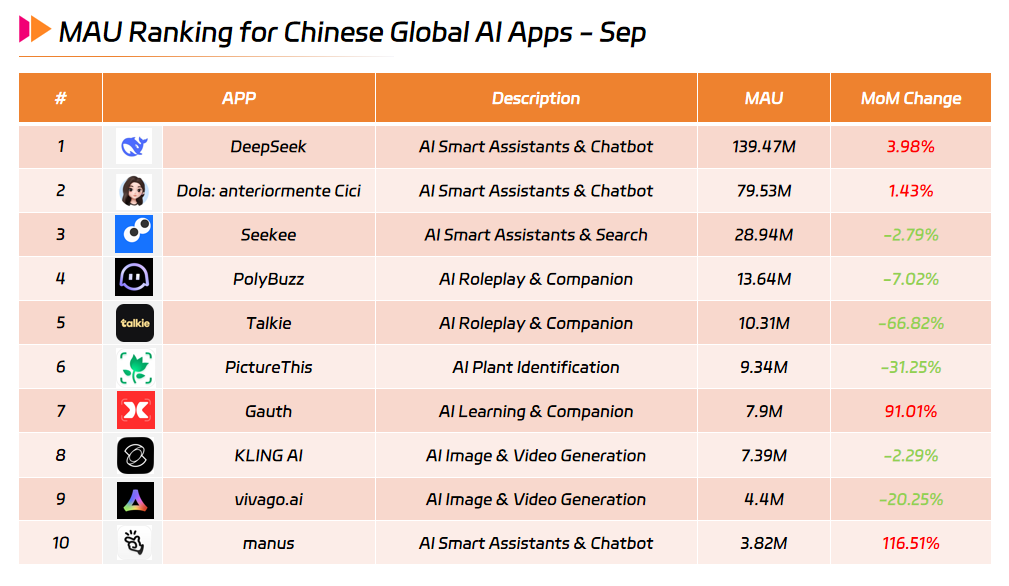
Among overseas-focused AI apps, DeepSeek ranked first with 130 million MAU, followed by Dola (formerly Cici) with 79.53 million and Seekee with 28.94 million. Other apps on the list included PolyBuzz, Talkie, Gauth, KLING AI, vivago.ai, and Manus.
DeepSeek and Dola have established substantially larger user bases than many competitors in global markets. However, growth within the rankings remains mixed. Gauth increased its MAU by 91.0% month over month, while Manus grew by 116.5%. By contrast, MAU for apps such as PolyBuzz and Talkie declined.
Source: aicpb.com
3. Case Studies: Trending AI Apps
AI Agent App: Muse
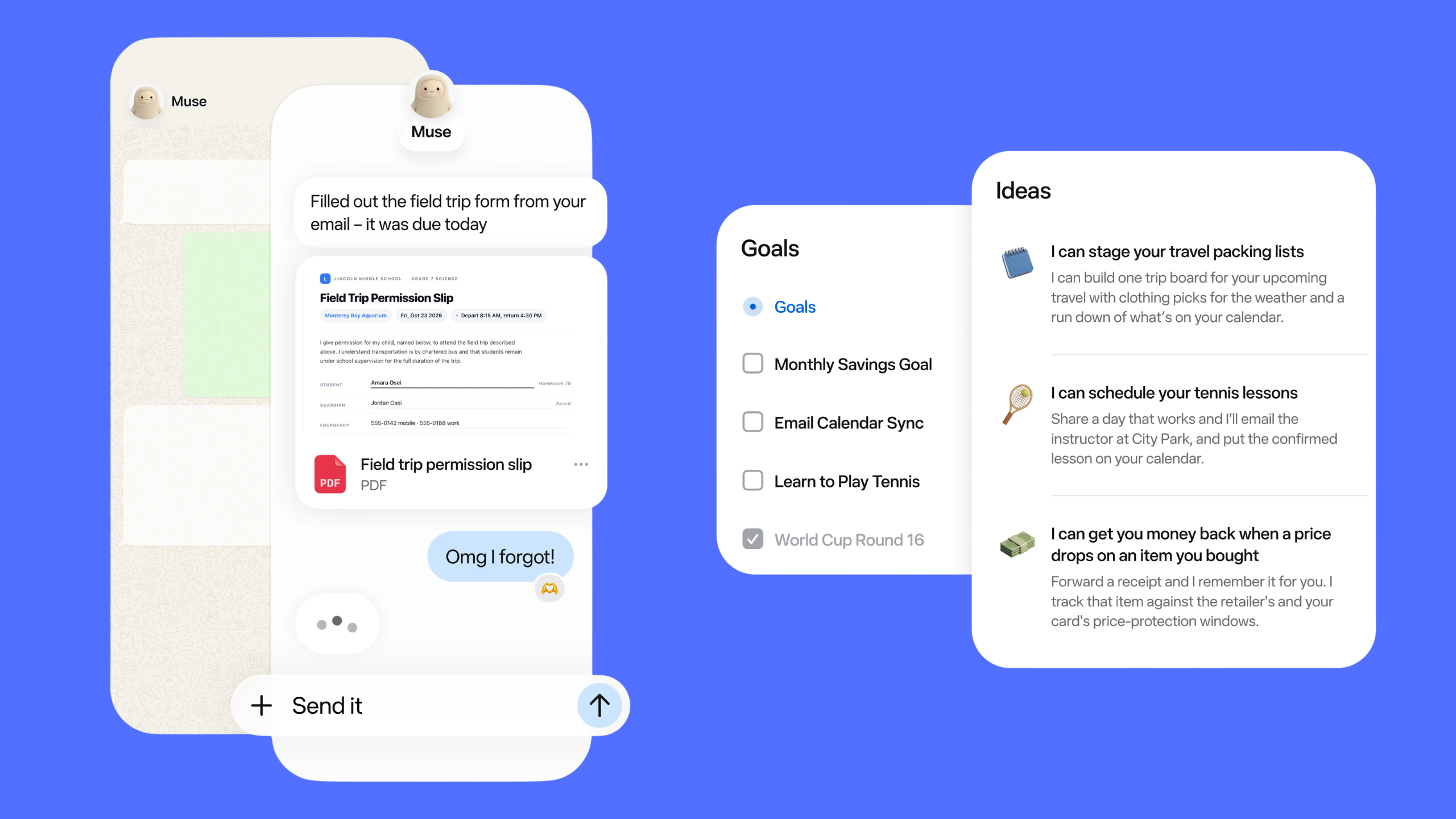
Muse is a personal AI agent launched by Meta, the parent company of Facebook, on September 8, 2026. Positioned as a “personal digital assistant,” it differs from traditional chatbots such as ChatGPT by focusing on completing tasks on the user's behalf.
Rather than simply responding to prompts, Muse can break down tasks and use tools to carry out multi-step activities, including web research, price comparisons, travel bookings, and email management.
Backed by Meta's extensive promotional reach, Muse experienced explosive growth in September. According to AppMagic data, global downloads exceeded 10 million, with growth heavily concentrated in the US. The US accounted for 95% of its total downloads.
Source: Muse
AI Social Companionship App: Zeta
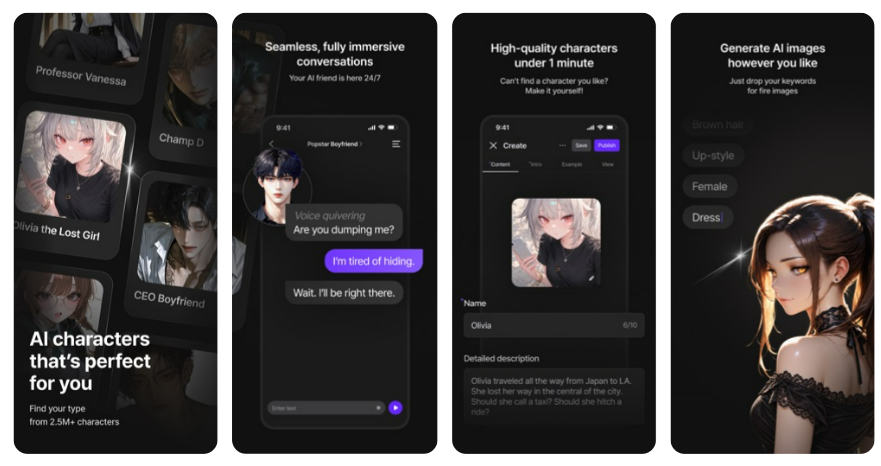
Zeta is an AI role-playing and interactive storytelling app developed by South Korean company Scatter Lab. It transforms AI conversations into immersive narrative experiences, allowing users to create or select characters and shape stories through interaction. Its user-generated content (UGC) ecosystem also enables users to create and share characters, helping attract new audiences.
By combining emotional companionship with interactive storytelling, Zeta differentiates itself from general-purpose AI chat apps.
According to AppMagic, Zeta has generated more than 10 million global downloads and over $20 million in IAP revenue, with ARPU exceeding $10. South Korea and Japan are its leading markets by paid revenue, accounting for 24% and 66%, respectively. Women make up approximately 65% of its user base.
Source: Zeta