

Global Hybrid-Casual Games Insights: Where Are the New Growth Opportunities in 2026?


Casual games continue to account for a significant share of global mobile game ad monetization. Across 19 key markets, hypercasual and casual mobile games generated $5.2 billion and $3.7 billion in ad revenue, respectively, together contributing nearly 80% of mobile game ad monetization revenue. Puzzle games generated another $5.3 billion, accounting for 53% of the category’s total revenue.
Against this backdrop, hybrid-casual puzzle games are expanding their reach and monetization potential through accessible gameplay, rich meta systems, and a combination of ad monetization and in-app purchases (IAP). However, as more titles enter the market, competition is intensifying.
What changes are shaping the global hybrid-casual puzzle market in 2026? Which subgenres are gaining momentum? And how should user acquisition strategies evolve? This article explores the latest market data and industry trends to identify emerging opportunities.
1. Global Hybrid-Casual Puzzle Market Trends
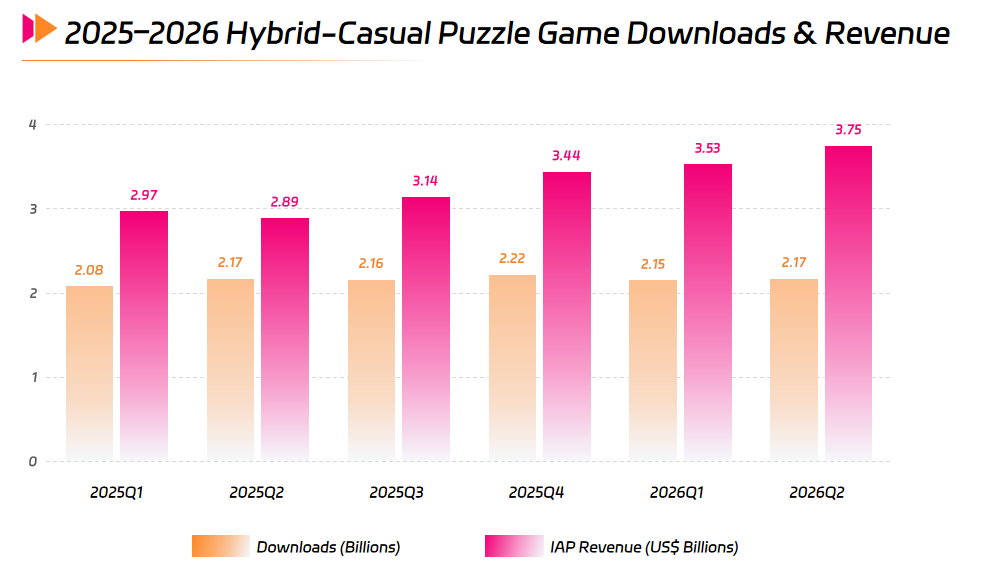
Since 2025, global hybrid-casual puzzle game downloads have remained relatively stable. Downloads reached 2.15 billion in Q1 2026 and 2.17 billion in Q2, with Q2 down just 0.04% year over year. Meanwhile, IAP revenue continued to grow, reaching $3.75 billion in Q2, up 29.5% year over year.
In H1 2026, global hybrid-casual puzzle games generated $7.277 billion in IAP revenue, up 24.0% year over year, while downloads reached 4.32 billion, an increase of 1.8%.
Source: Diandian Data
Stable downloads, rising revenue has become a defining feature of the global hybrid-casual puzzle market. As download growth slows, expansion is increasingly driven by improving product value and monetization efficiency rather than simply acquiring more users.
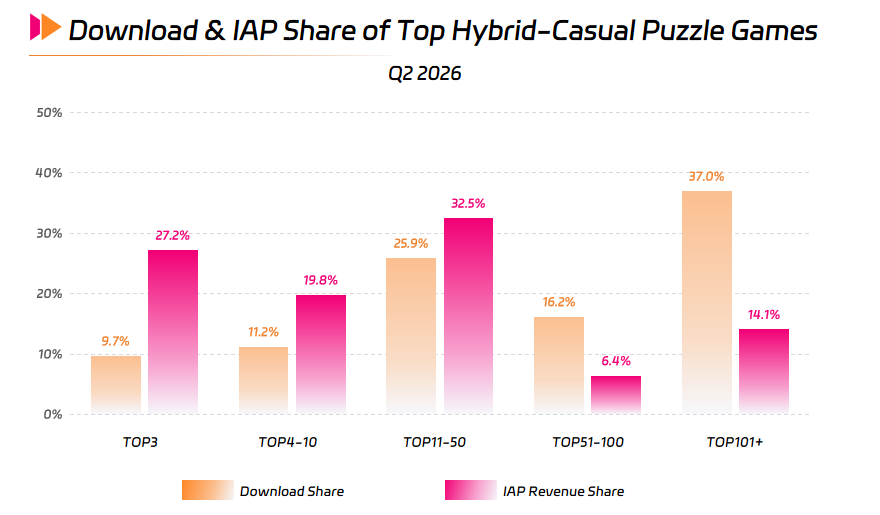
Market concentration also reveals a clear divide between downloads and revenue. In Q2 2026, the top 100 games accounted for approximately 63% of total downloads. Revenue was more concentrated: the top 10 titles generated 47.0% of total IAP revenue, while the top 50 accounted for 79.5%.
Source: Diandian Data
This suggests that opportunities to acquire users remain relatively broad, while revenue is increasingly concentrated among leading titles. Scaling downloads does not automatically translate into sustained monetization, leaving a significant gap between user acquisition and revenue generation.
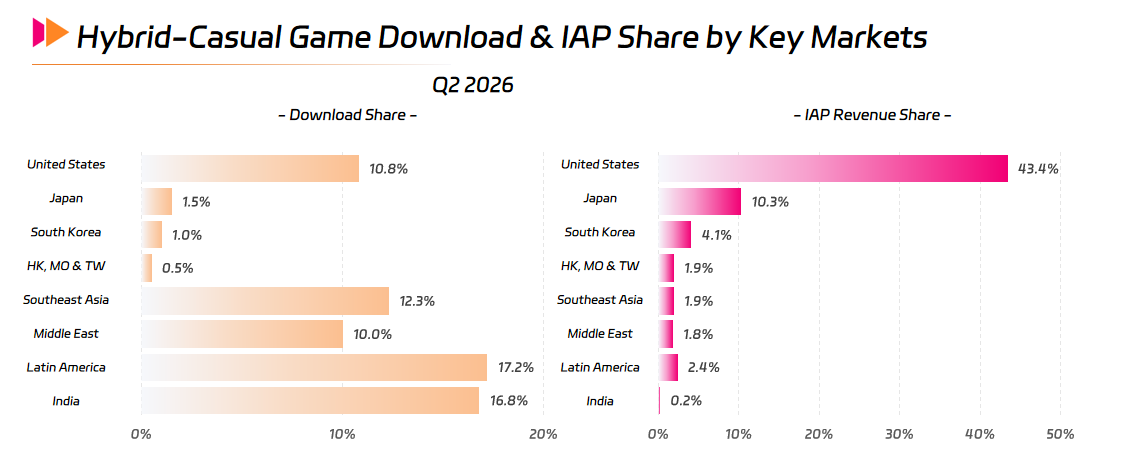
Regional growth patterns are also diverging. Mature markets such as the US, Japan, and South Korea contribute a larger share of revenue, with the US accounting for 43.4% of total IAP revenue. Meanwhile, growth markets such as Southeast Asia, Latin America, and India offer greater download volume, representing 12.3%, 17.2%, and 16.8% of downloads, respectively.
Source: Diandian Data
These markets play different roles in a growth strategy. Mature markets drive monetization depth and user value, while emerging markets offer broader reach and opportunities to scale acquisition.
2. Subgenre Insights: Emerging Winners and Established Growth Drivers
Against a backdrop of stable downloads and rising revenue, performance varies significantly across subgenres. Sorting puzzles and merge games illustrate two distinct growth paths: the rapid rise of an emerging subgenre and the continued expansion of an established one.
2.1 Sorting Puzzles: From Niche Subgenre to Fast-Growing Opportunity
Sorting puzzles have attracted growing attention in the global hybrid-casual puzzle market over the past few years, although their scale remained relatively limited compared with other major subgenres.
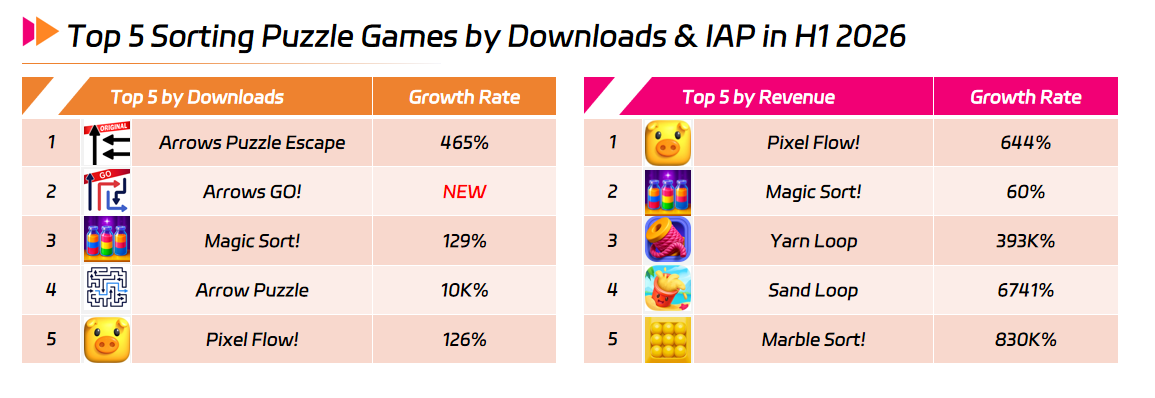
That began to change in early 2026. Driven by the rapid growth of Pixel Flow, sorting puzzles surpassed blast puzzles in IAP revenue, becoming the third-largest puzzle subgenre by IAP revenue.
Momentum strengthened throughout H1 2026. Global sorting puzzle games recorded 130% half-over-half growth in IAP revenue and 65% growth in downloads. Revenue also surged 335% year over year. Titles such as Arrows Puzzle Escape, Arrows GO!, and Arrow Puzzle ranked among the games with the fastest download growth.
Source: Sensor Tower
Having moved from a relatively niche segment into the upper tier of the puzzle market, sorting puzzles are emerging as one of the more notable growth opportunities in 2026. Their rapid rise may also offer smaller studios a way to enter the market without competing directly in more saturated gameplay categories.
2.2 Merge Games: Sustained Growth in a Mature Subgenre
Unlike sorting puzzles, merge games have an established product format and market foundation, yet continue to deliver solid growth. In H1 2026, global merge games saw IAP revenue increase 37% half over half and 93% year over year, demonstrating that this mature subgenre still has substantial revenue potential.
Among leading titles, Gossip Harbor and Tasty Travels continued to rank among the top-grossing merge games. Looking more closely at titles with strong revenue and growth, story-driven, cooking, and decoration themes stood out as important growth drivers.
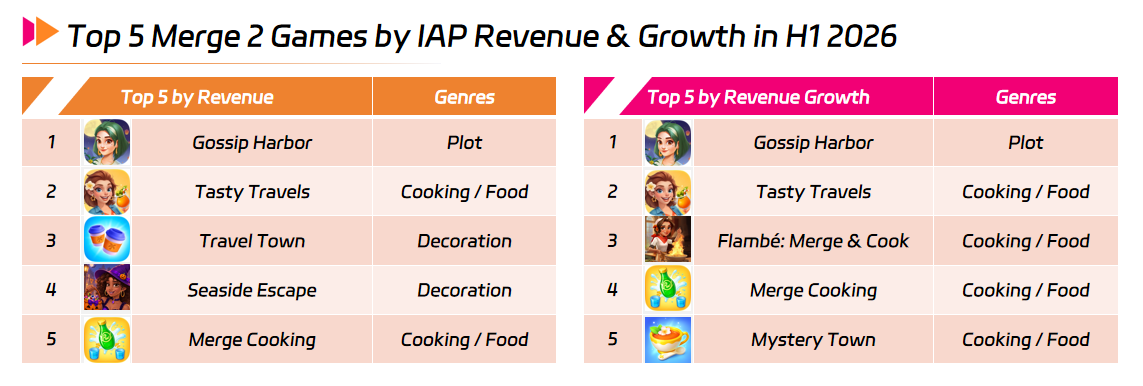
Source: Sensor Tower
By building on proven merge mechanics while differentiating through themes and content, developers can continue to unlock new growth. This offers content-savvy teams an opportunity to compete through distinctive themes and compelling presentation without needing to reinvent core gameplay.
3. User Acquisition Strategies for Global Hybrid-Casual Puzzle Games
From the rapid rise of sorting puzzles to the sustained growth of merge games, different subgenres offer distinct opportunities, while raising the bar for user acquisition. As a category heavily reliant on paid acquisition, hybrid-casual puzzle games need closer alignment between gameplay design, product development, and ad creative.
Creative assets must do more than attract attention. They need to communicate the appeal of core gameplay clearly, while product and creative strategies should evolve continuously based on market feedback.
3.1 Turn Core Gameplay into Instantly Understandable Creatives
Hybrid-casual puzzle games often feature clear objectives and visual feedback. Ad creatives can focus on puzzle-solving, level progression, chain reactions, and goal completion to help users quickly understand the gameplay. Highlighting the contrast between the challenge and its resolution can make an ad more compelling than simply showcasing gameplay footage.
3.2 Validate Creative Concepts Early in Product Development
Ad creatives should serve more than a promotional purpose after launch. Videos and playable ads can test different mechanics, themes, and gameplay experiences during early development, helping teams gather user feedback before committing to a full product direction.
Click-through rates can indicate initial appeal, while retention and subsequent user behavior help determine whether the actual gameplay meets expectations. These insights can then inform product design and creative iteration.
3.3 Build Creative Variations Around Core Mechanics
Creative iteration does not always require starting from scratch. Developers can preserve recognizable core mechanics while exploring variations in level objectives, obstacles, power-up combinations, narrative scenarios, and visual themes. This approach maintains gameplay identity while creating more opportunities to test new creative concepts.
Conclusion
The opportunities in the global hybrid-casual puzzle market in 2026 are increasingly structural rather than evenly distributed. Sorting puzzles are generating incremental growth through rapid expansion, while merge games continue to deepen their presence in an established market. Mature regions drive revenue, while emerging markets contribute greater scale.
For global game publishers, choosing the right subgenre is only the first step. The greater challenge is translating distinctive gameplay into creative assets that users immediately understand, then refining product direction through continuous testing and market feedback.
As downloads stabilize and revenue becomes more concentrated, sustainable acquisition growth will depend less on isolated breakthroughs and more on the coordinated optimization of product design, ad creative, and user acquisition.