

High Growth, Low ARPU? Inside Southeast Asia's Next Growth Phase for Short-Drama Apps


If the past few years marked the expansion of short-drama apps from China to global markets, 2026 is shaping up to be one of the steepest parts of that growth curve in Southeast Asia.
The numbers tell the story. One in every 20 mobile app downloads in Southeast Asia now comes from a short-drama app. In Q2, short-drama adoption continued to accelerate, with three short-drama apps ranking among the region's top 10 apps by downloads. The category also claimed two spots among the top 10 apps by revenue.
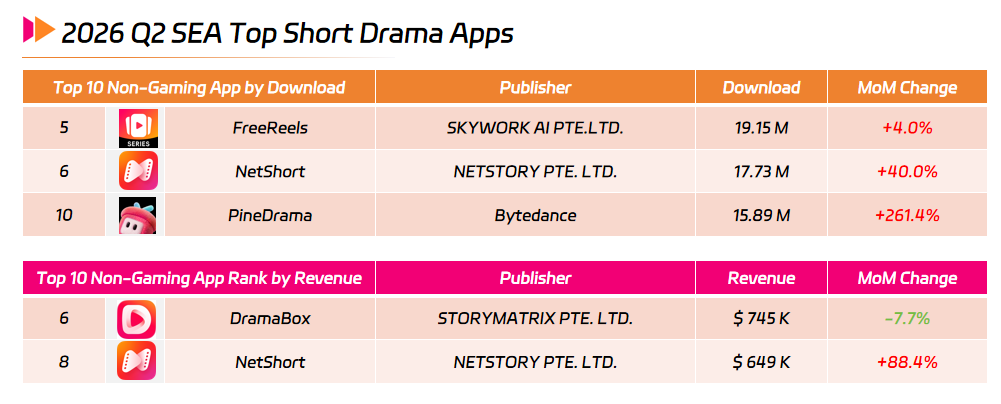
With both user acquisition and monetization gaining traction, short drama in Southeast Asia is moving beyond a temporary content trend and evolving into a long-term mobile business opportunity.
But how large is this growth opportunity in such a diverse and complex region? Who are the leading players? And what does the current user acquisition landscape tell us about the next stage of the market?
In this analysis, we examine Southeast Asia's accelerating short-drama market through market size, monetization, user acquisition, advertising activity, and competitive dynamics.
Ⅰ. Southeast Asia's Short-Drama Market: A Growing User Base with Room for Monetization
Looking at the performance of non-gaming app categories in Southeast Asia in 2025, Media & Entertainment stands out as one of the most important growth segments.
On the download side, Media & Entertainment ranked among the fastest-growing categories, generating 360 million incremental downloads, up 62% year over year. The category also expanded on the revenue side, with IAP revenue increasing by $110 million, or 25% YoY.
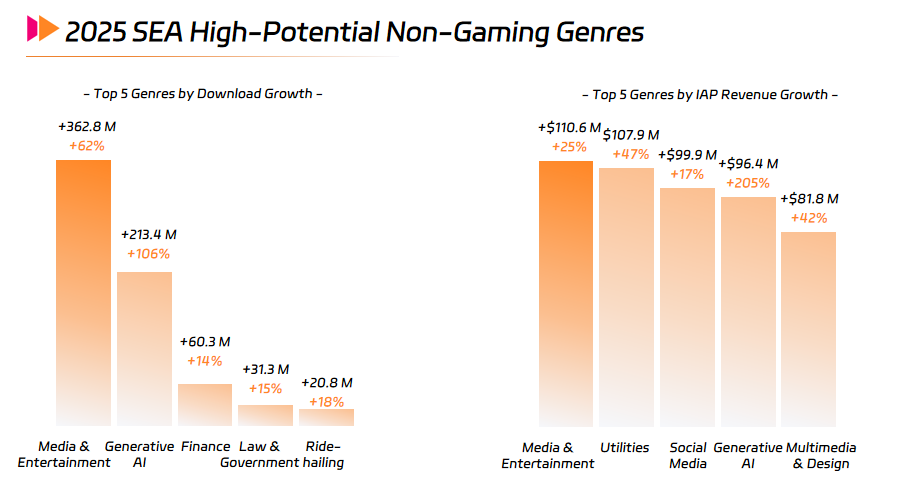
This reflects Southeast Asian users' continued appetite for digital entertainment, with short-drama apps emerging as one of the most prominent formats benefiting from this demand.
From a global perspective, Southeast Asia had already become the largest region for short-drama app downloads in Q1 2026, accounting for 32% of global downloads, ahead of other major markets such as Latin America and India.
However, the regional picture looks very different when it comes to IAP revenue.
The global short-drama market shows a clear two-tier structure in monetization. The U.S. accounts for 37% of global IAP revenue, giving it the strongest overall monetization capacity. Europe contributes another 19%, while Southeast Asia accounts for just 9%.
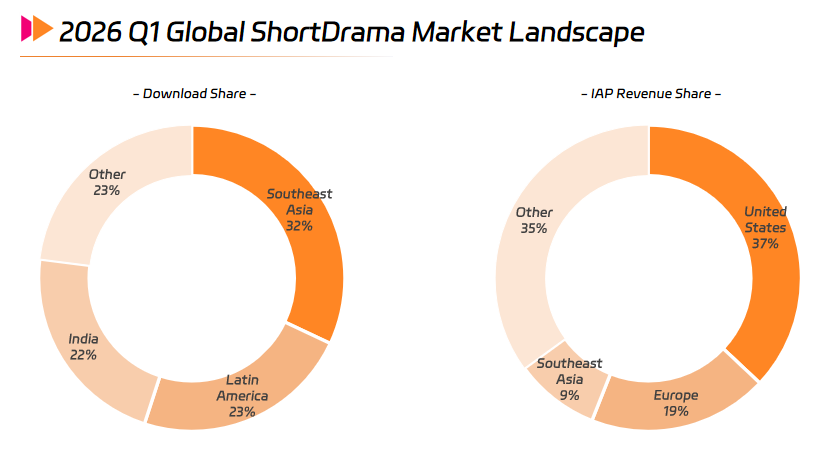
This gap highlights a broader trend in the global short-drama market: emerging markets are driving user expansion, while mature markets are moving toward a more stable growth phase.
Southeast Asia, Latin America, and India remain in relatively strong user-growth stages, with some markets recording significant increases in downloads. By comparison, mature markets such as the U.S. and Europe are seeing more limited growth, with some markets even experiencing declines.
The revenue picture further underscores the differences in market maturity.
The U.S. continues to generate substantial IAP revenue, but growth pressure is becoming more apparent. Southeast Asia, meanwhile, still has significant room for user expansion, while its monetization scale remains relatively limited.
For short-drama platforms, increasing ARPU and improving payment penetration will therefore remain key challenges as the market scales.
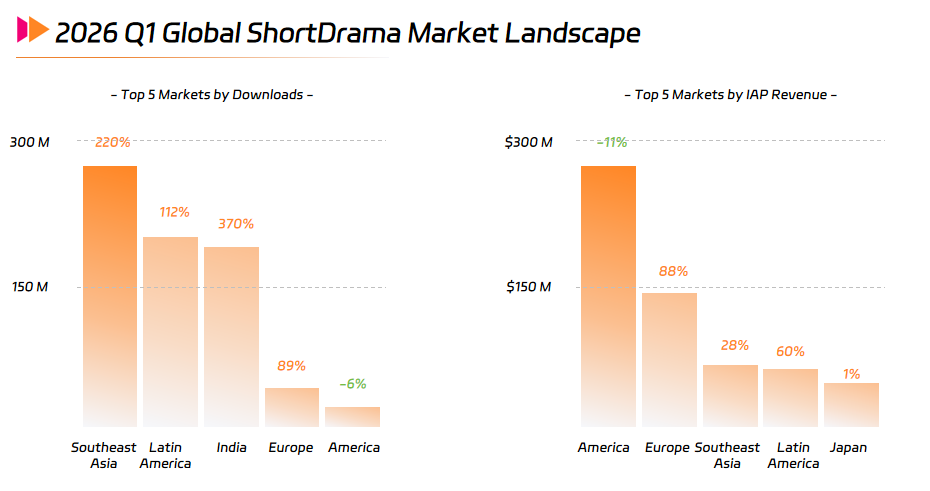
Ⅱ. Southeast Asia Short-Drama Marketing: High Growth, Lower Competition, and Rising Creative Pressure
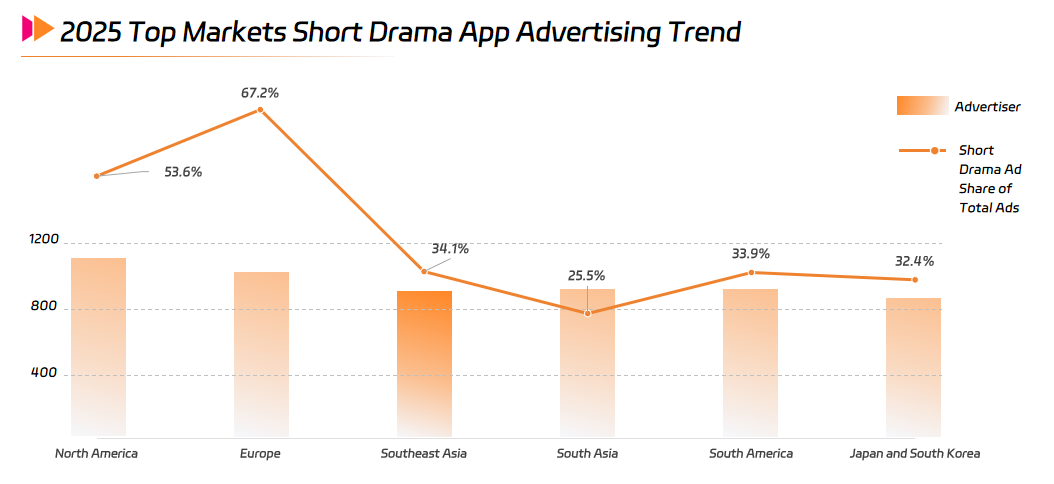
On the marketing side, North America and Europe remain key markets for advertisers thanks to their higher consumer spending power. However, competition is also becoming increasingly intense, with short-drama ads accounting for 53.6% and 67.2% of total advertising activity in the two regions, respectively.
Southeast Asia presents a different picture.
The region ranks in the middle in terms of advertiser scale, while short-drama ads account for 34.1% of total advertising activity. Overall, the market remains relatively healthy and has not yet reached the saturation levels seen in some mature markets.
For global app publishers, this makes Southeast Asia an attractive market for balancing user acquisition efficiency and scalable growth. The region combines relatively cost-efficient traffic with considerable room for additional advertising investment.
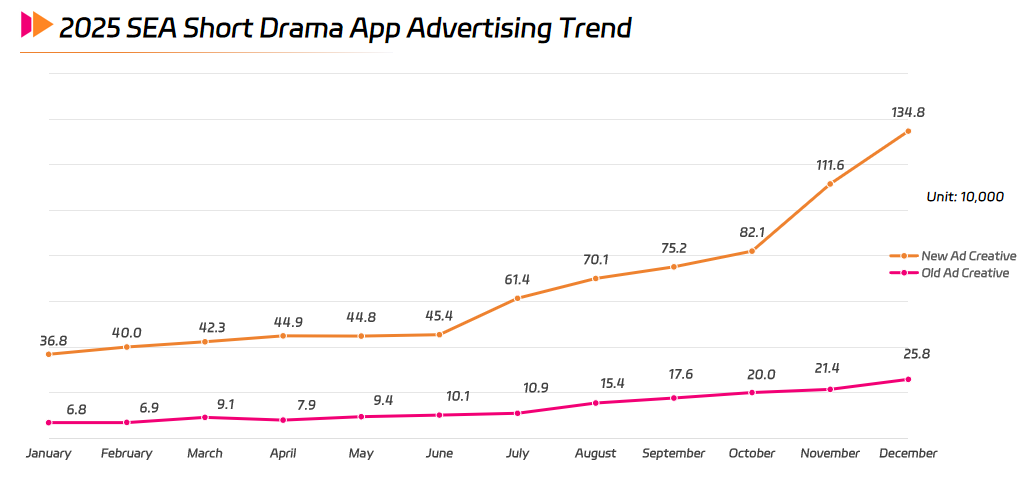
In 2025, short-drama advertising activity in Southeast Asia showed a particularly strong upward trend.
The number of new ad creatives increased steadily throughout the year, before accelerating sharply in the second half, particularly from October to December.
By December, the number of new creatives reached 1.348 million in a single month, while existing creatives also increased to 258,000. The ratio of new to existing creatives expanded to approximately 5:1.
This rapid creative turnover reflects growing user fatigue with repetitive storylines and ad formats. For advertisers, maintaining a high frequency of creative refreshes and content iteration is becoming increasingly important.
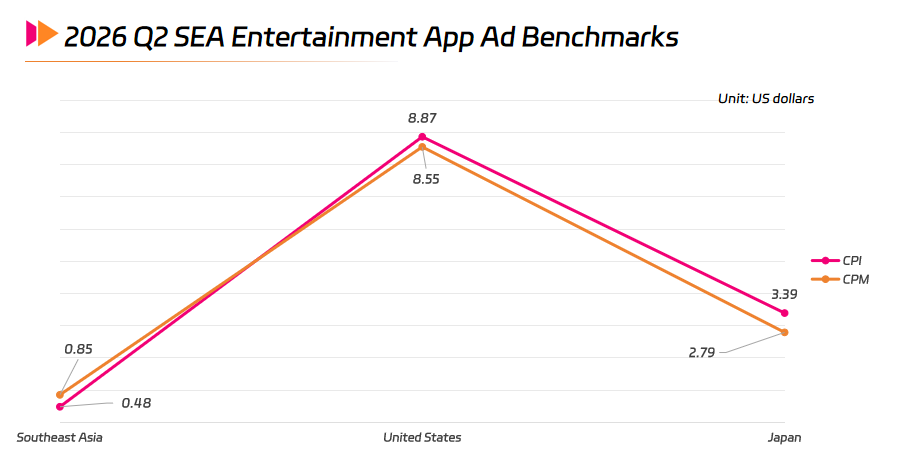
From a user acquisition perspective, Southeast Asia remains one of the most cost-efficient traffic markets globally.
The region's CPI stands at just $0.48, while CPM is $0.85, both representing relatively low acquisition costs.
The contrast with mature markets is significant. In the U.S., CPI and CPM reach $8.87 and $8.55, respectively, while Japan records $3.39 CPI and $2.79 CPM.
A lower CPI allows platforms to acquire a larger user base at a relatively controlled cost. However, low acquisition costs do not automatically translate into high ROI. Ultimately, retention, monetization, and lifetime value determine whether low-cost traffic can generate sustainable returns.
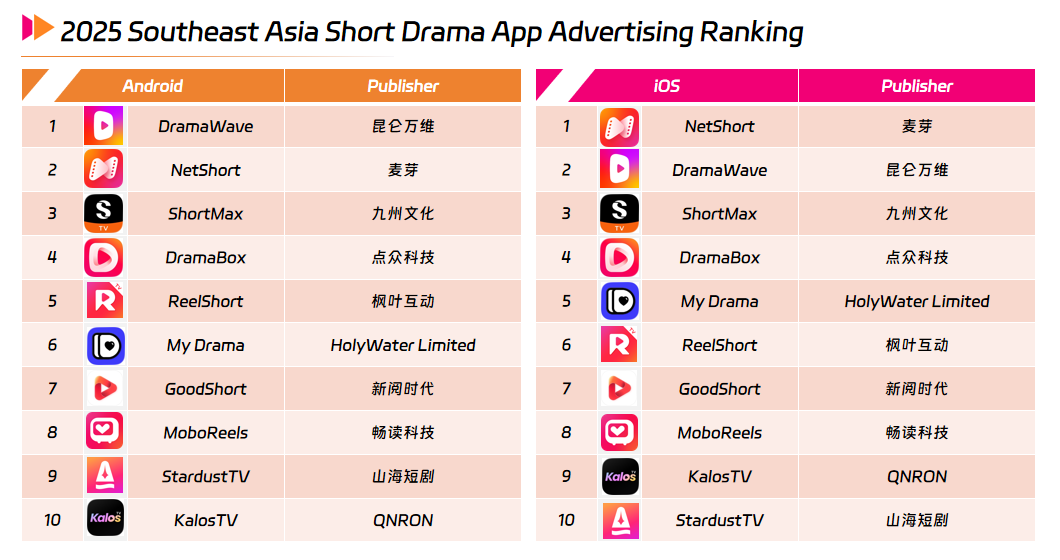
Among the top 10 short-drama apps by advertising volume, DramaWave, backed by Kunlun Tech, ranked first on Android. Other leading platforms, including NetShort, ShortMax, and DramaBox, also occupied prominent positions.
On iOS, NetShort and DramaWave likewise led the market, while GoodShort and MoboReels also entered the top 10 through highly targeted user acquisition strategies.
Overall, the competitive landscape shows that a significant share of short-drama user acquisition in Southeast Asia is concentrated among Chinese publishers with extensive experience in international expansion.
This concentration is accelerating the Matthew effect in the market, creating increasingly high barriers for new entrants.
Ⅲ. Conclusion: From Scale-Driven Growth to Long-Term Monetization
Southeast Asia's short-drama market is currently characterized by high growth and relatively low ARPU.
A $0.85 CPM and strong download growth highlight the region's cost-efficient potential as a scalable user-acquisition market. At the same time, its 9% share of global IAP revenue indicates that monetization maturity still lags behind user growth.
For global publishers, the rise of short drama in Southeast Asia is more than a story of rapidly expanding user numbers. It signals the formation of a new mobile monetization market that is entering a more mature stage of development.
Southeast Asia therefore remains an important market for strategic investment, but the growth logic is shifting from simply scaling acquisition to long-term, data-driven optimization.
The next phase will depend on how effectively publishers balance acquisition costs with LTV, improve retention and monetization, and build a sustainable growth loop.
Ultimately, scale is only the starting point. Turning low-cost user acquisition into long-term value will determine who can convert Southeast Asia's short-drama boom into sustainable profitability.