

The Evolution of Hyper-Casual Games: NetMarvel's Perspective on Breaking Through the Market Ceiling


The turbulence in the mobile gaming market over the past two years has left many hyper-casual developers searching for direction. According to Sensor Tower data, declining downloads and rising user acquisition costs have become industry-wide challenges. But beneath the surface lies an overlooked reality: hyper-casual games are not dying — they are evolving through a new “hybrid casual” model.
As broad, volume-driven UA strategies struggle to sustain ROI, the evolution path of hyper-casual games has become increasingly clear: shifting from a single core gameplay loop toward a combination of lightweight mechanics and long-term casual live operations.
1. Market Reshaping: From Download-Driven to LTV-Driven Growth
Looking back at market changes from 2025 to 2026, downloads across most categories have faced pressure, yet top-performing titles have managed to double their monthly revenue against the trend. The reason is straightforward: developers have learned how to transform users from “one-time traffic” into long-term retained value through LiveOps and refined in-app purchase (IAP) systems.
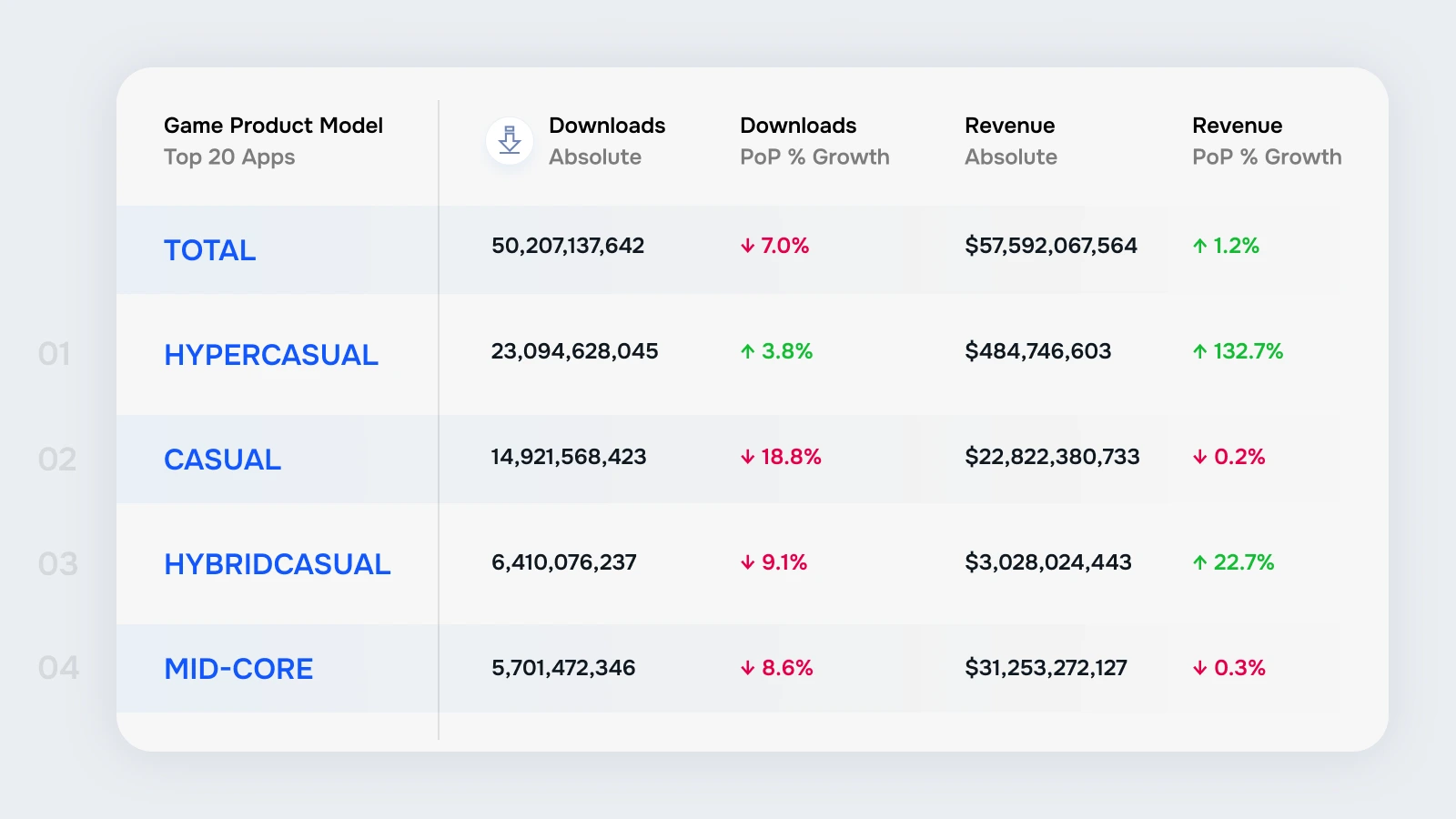 Mobile game market data for Q1 2026. Data source: Sensor Tower.
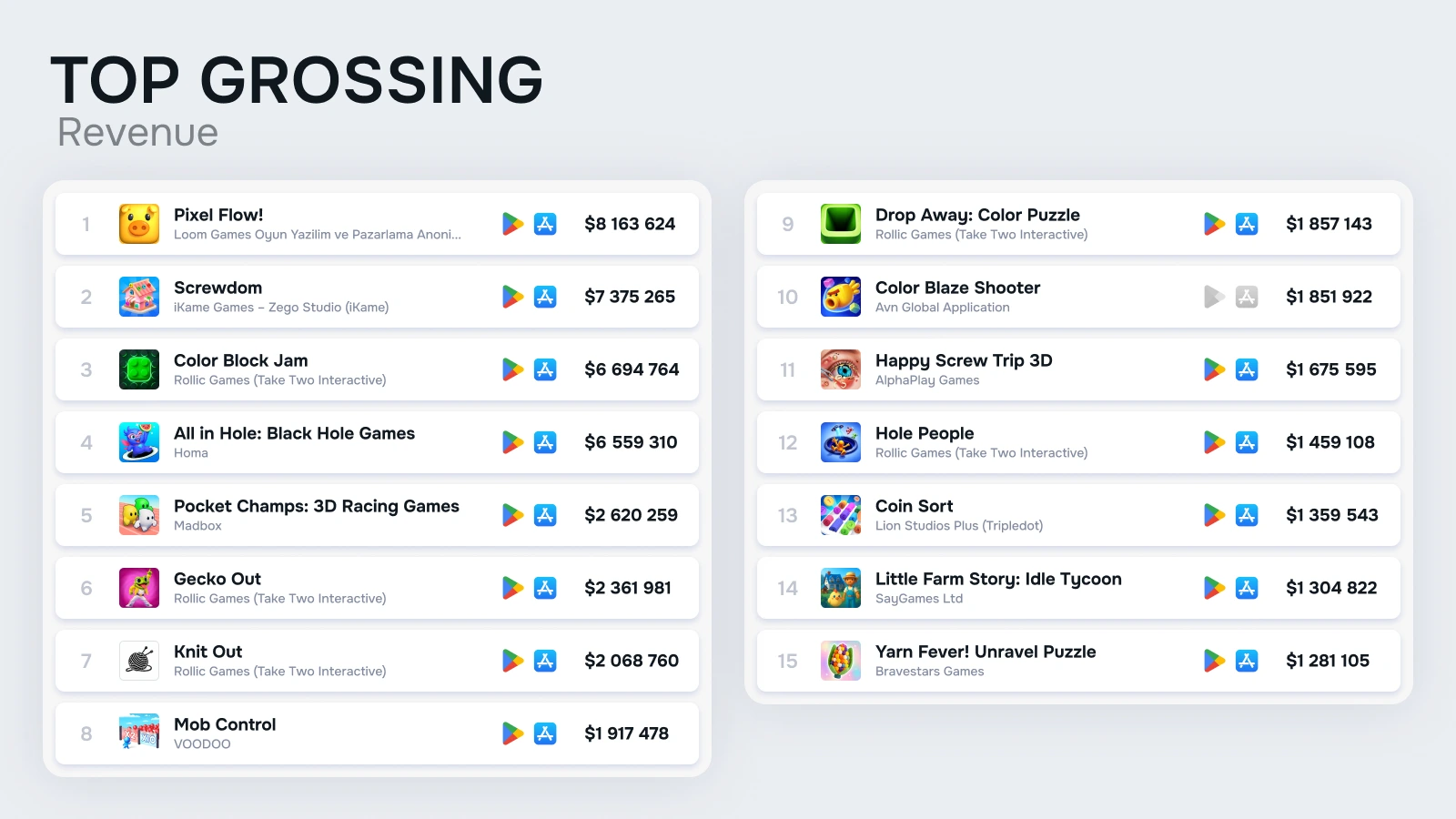
In-app purchase (IAP) revenue for hyper-casual games in 2025. Data source: Sensor Tower.
Today's leading hyper-casual games still rely on extremely simple core gameplay, but their scaling and monetization strategies increasingly borrow from the mature playbook of casual games: introducing new mechanics every 10–15 levels, implementing win-streak systems, and maintaining high-frequency live events. As a result, the barrier to success has risen dramatically. Without strong 30-day retention, profitability is nearly impossible.
During this industry transition, NetMarvel has remained committed to providing developers with full-funnel support, from traffic acquisition to monetization optimization. For mid-sized studios, building a sophisticated global UA and retention monitoring system can be resource-intensive and difficult to sustain. By leveraging deep advertising ecosystem integration and advanced traffic insights, NetMarvel helps developers maximize player lifetime value through efficient acquisition strategies and refined ad placement optimization, even in a market where downloads are slowing.
2. The Core Evolution: “Easy to Enter, Deep to Engage”
Today's hyper-casual market is essentially “hyper-casual on steroids.” The genre still maintains a low barrier to entry, but now incorporates meta-progression systems similar to games like Royal Match. The success of this model comes from using AI-assisted content generation to continuously deliver fresh experiences to players.
This means developers can no longer focus solely on core gameplay. They must also rethink how monetization systems are integrated into simple game loops. For example, how should teams balance ads and in-app purchases? Inexperienced developers may simply remove ads for paying users, but experienced operators understand that paying users are not necessarily “anti-advertising” — they are often highly engaged users with stronger content consumption intent.
This is where NetMarvel creates meaningful value. Beyond traffic acquisition, NetMarvel's platform focuses heavily on monetization logic and the balance between ads and IAP systems. By modeling behavioral patterns across different player segments, NetMarvel helps developers implement dynamic monetization strategies that maximize ad efficiency without disrupting the gameplay experience — turning ads into engagement enhancers rather than user frustration points.
3. The Future of Growth: Fine-Tuned Operations as the Ultimate Competitive Edge
The future of gaming no longer belongs to companies that simply “buy traffic.” It belongs to teams that deeply understand user behavior.
The industry often categorizes players as “whales” or “dolphins,” but in today's era of refined operations, those labels are no longer enough. Two users with the same $100 LTV can represent completely different behaviors: one may spend $100 in a single transaction, while another may make ten separate $10 purchases over time. These patterns imply entirely different retention risks and content consumption cycles. Identifying and acting on these nuances is becoming critical for effective UA optimization.
At present, many mid-sized studios are limited by technical and operational constraints, making this level of behavioral modeling difficult to achieve. But market pressure is forcing the industry to evolve — from download-driven growth toward LTV-driven operations.
4. Conclusion
Every year, predictions emerge claiming that hyper-casual gaming is “dead.” Yet the market continues to prove otherwise. As long as developers remain willing to experiment, iterate, and evolve their operational models, the category still holds enormous potential.
The real question is no longer whether you can acquire users at scale — it's whether you are prepared to evolve from a “traffic buyer” into a true “operations expert.” As downloads stop being the sole benchmark of success, deep data analysis and sophisticated lifecycle management will define the next decade of competition in mobile gaming.
For developers looking to reduce UA costs while maximizing long-term user value, NetMarvel is ready to help navigate the next wave of transformation and unlock sustainable growth opportunities in the evolving global gaming market.