
April Global AI App Market Analysis: General AI Assistants Continue to Lead as Vertical AI Segments Accelerate Breakthrough Growth


In April 2026, as leading large language models continued to evolve, competition in the global AI app market intensified further. The industry still follows a “one dominant player, several strong challengers” pattern: ChatGPT remains firmly ahead thanks to its massive user base, while products such as Google Gemini and Claude continue to gain momentum.
Meanwhile, the supply side of the AI app market is entering a new growth cycle. According to Appfigures, global app launches increased 60% YoY in Q1 2026, while early April data surged even further to 104%. The maturity of AI-assisted development, low-code, and no-code tools is lowering development barriers and accelerating expansion across productivity, utility, and lifestyle categories.
Looking back at April, what new trends emerged in the global AI app market? Which vertical segments are breaking out? Based on the latest data and product performance, this report explores the evolving market landscape.
1. The AI Market's Head Structure Remains Firm as the Matthew Effect Intensifies
In April, general-purpose AI assistants remained the category with the highest user penetration and most mature usage habits.
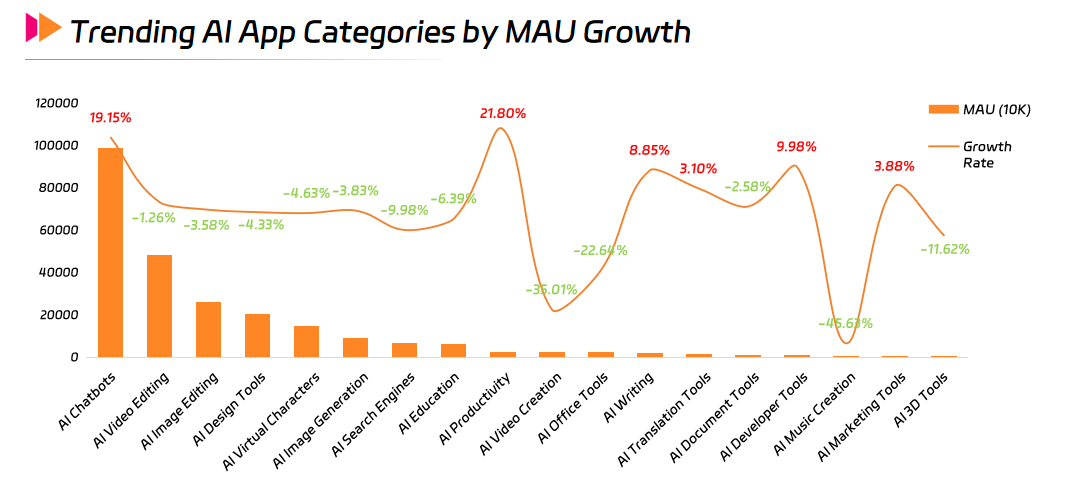
According to Xsignal data, AI chatbots continued to dominate the market with nearly 1 billion MAU and 19.15% growth. Meanwhile, AI productivity, AI writing, and AI development tools achieved growth rates of 21.8%, 8.85%, and 9.98%, respectively, as user demand increasingly concentrated around high-frequency utility scenarios.
In contrast, content-generation categories that previously saw explosive growth have entered a phase of adjustment. AI video creation, AI music generation, and AI office tools declined by 35.01%, 45.63%, and 22.64%, respectively, while AI image editing and AI design tools also experienced moderate slowdowns.
At the app level, the global AI market now shows a clear “stable top-tier structure with intensifying winner-takes-all dynamics.”
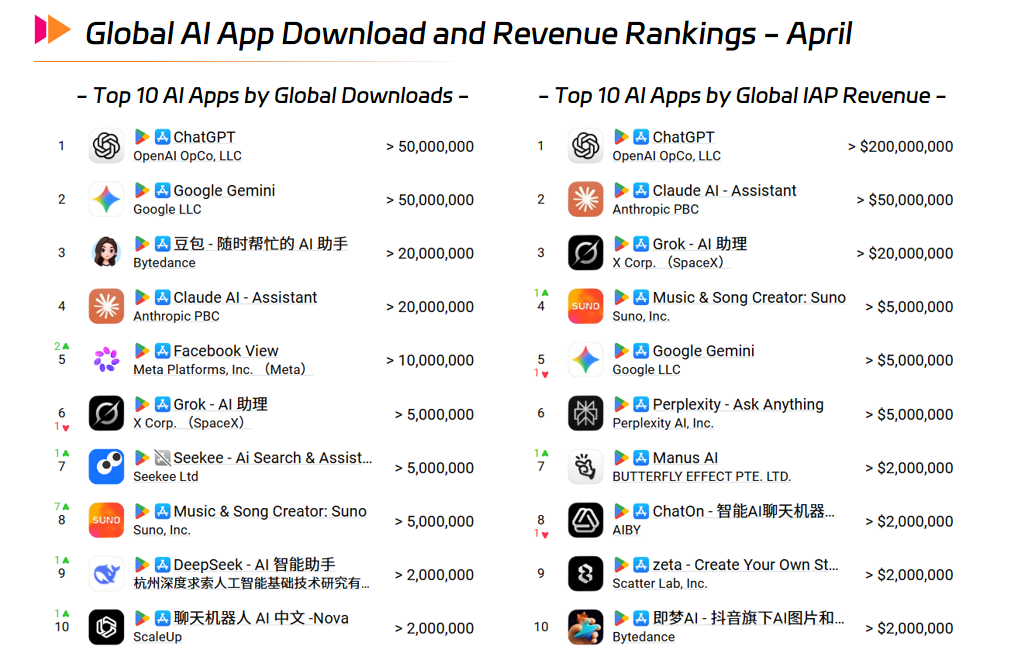
ChatGPT and Google Gemini firmly remained in the top download tier, both surpassing 50 million downloads and demonstrating the overwhelming traffic concentration of leading products.
On the monetization side, ChatGPT generated over $200 million in monthly revenue, more than four times that of second-place Claude.
At the same time, vertical AI segments are accelerating monetization.
Although their download scale remains smaller than general AI assistants, products such as Suno and Manus AI delivered strong revenue performance, surpassing $5 million and $2 million respectively. This further validates the rapid maturation of “AI + vertical scenarios” business models, as users are increasingly willing to pay for tools that directly generate finished outputs or significantly improve productivity.
2. ChatGPT Growth Slows While AI Plant Recognition Emerges as a Highlight
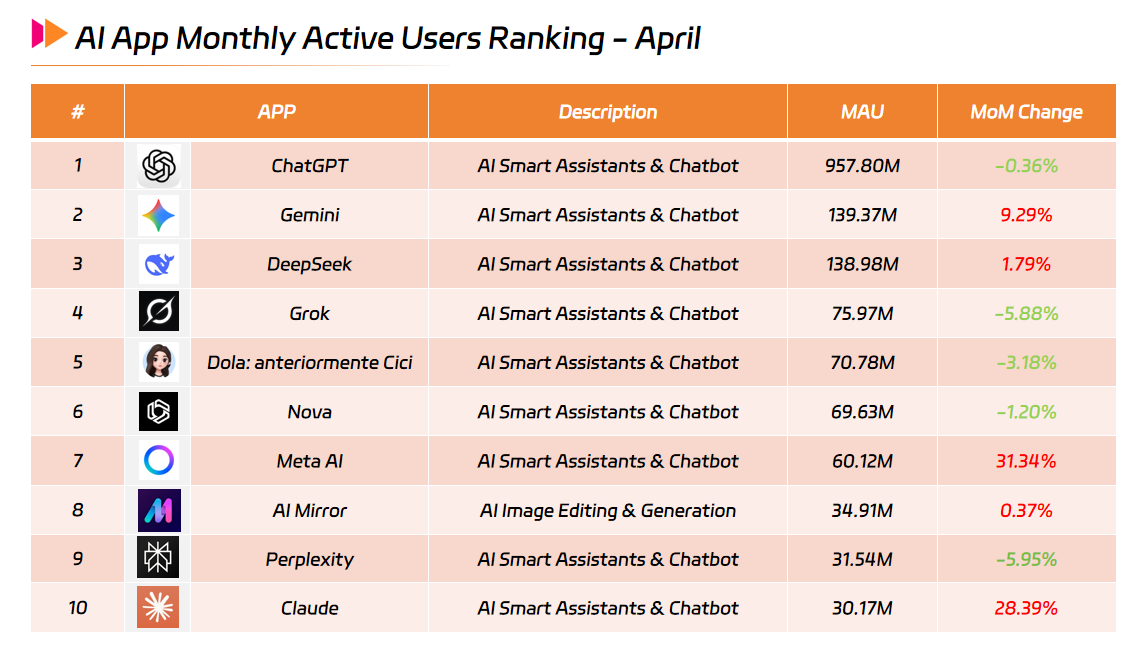
In terms of monthly active users, ChatGPT continued to dominate with nearly 1 billion MAU, although its growth has slowed for two consecutive months.
Meanwhile, Google Gemini and DeepSeek ranked second and third with around 140 million MAU each. Gemini maintained strong momentum with 9.29% growth, while DeepSeek grew 1.79%.
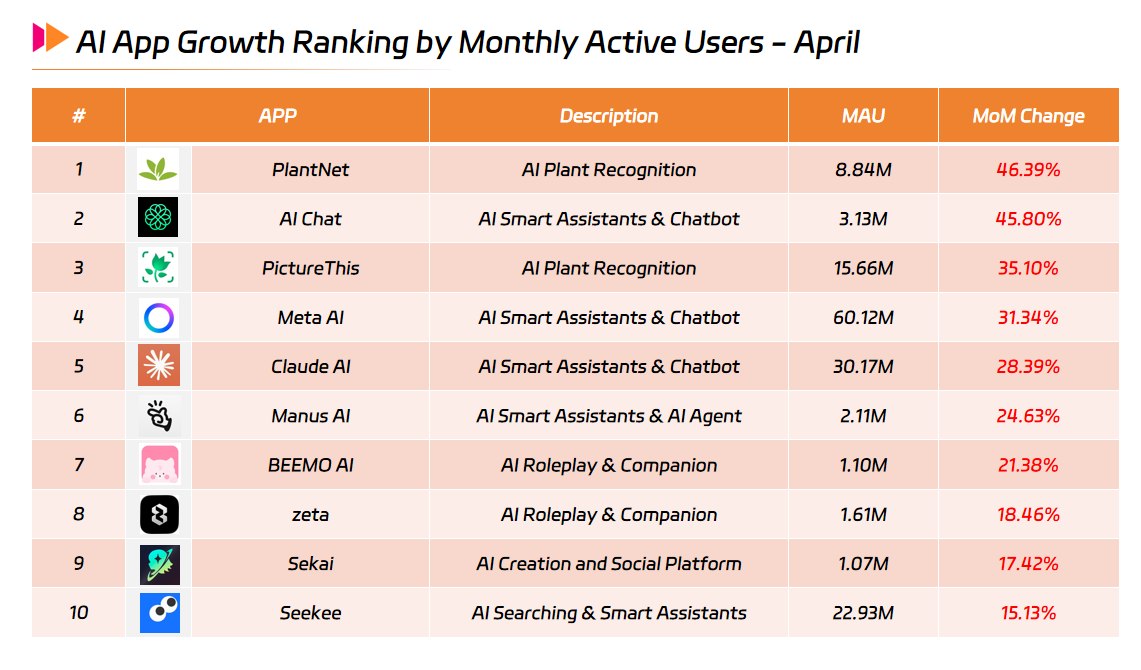
Notably, Meta AI and Claude surged by 31.34% and 28.39%, respectively, benefiting from rapid product iteration and model upgrades. In contrast, Grok and Perplexity both declined by more than 5%, facing increasing retention pressure.
Overall, nine of the top ten MAU apps were chatbot products. AI Mirror was the only image-editing app to enter the top ten, though its growth was limited to just 0.37%, suggesting that non-chatbot categories still face significant breakout challenges.
From a growth-rate perspective, plant recognition apps emerged as April's standout segment. PlantNet and PictureThis achieved MoM growth of 46.4% and 35.1%, highlighting the strong demand and growth potential of vertical utility AI apps.
Meanwhile, Meta AI and Claude sustained strong growth following model upgrades. AI companion apps such as BEEMO AI and zeta grew by 21.4% and 18.5%, respectively. AI interactive content platform Sekai increased 17.4% MoM, surpassing 1 million MAU.
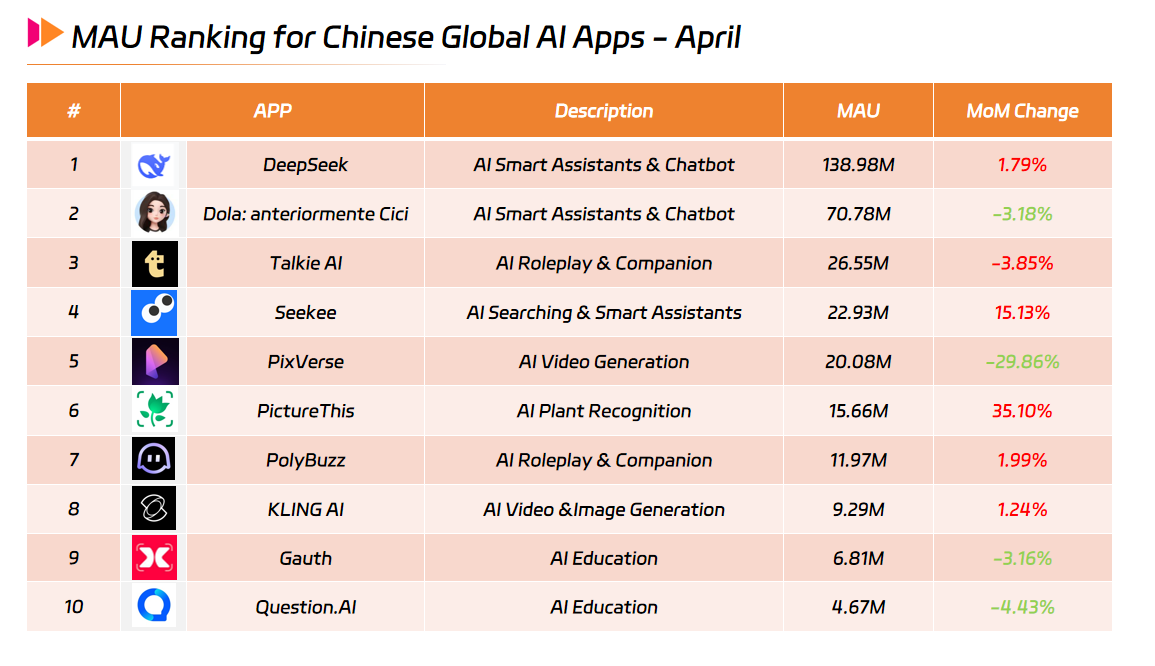
Among Chinese AI apps expanding globally, AI assistants with strong Q&A, search, and utility integration capabilities remained the dominant growth direction. DeepSeek held the top spot with 139 million MAU and continued growth, while Seekee grew 15.13% MoM.
Vertical AI apps also delivered strong performance. PictureThis grew 35.1%, making it one of the fastest-growing apps on the chart.
At the same time, AI companion apps maintained stable popularity. Products such as Talkie AI and PolyBuzz continued ranking among the top apps, demonstrating strong user stickiness for virtual character and emotional interaction experiences.
However, the AI video generation segment is clearly cooling down. PixVerse saw MAU decline nearly 30% MoM, suggesting content-generation products are transitioning from a “traffic explosion phase” into a stage focused on retention and quality competition.
3. Featured AI Appsn segm
AI Interactive Social Platform — Sekai
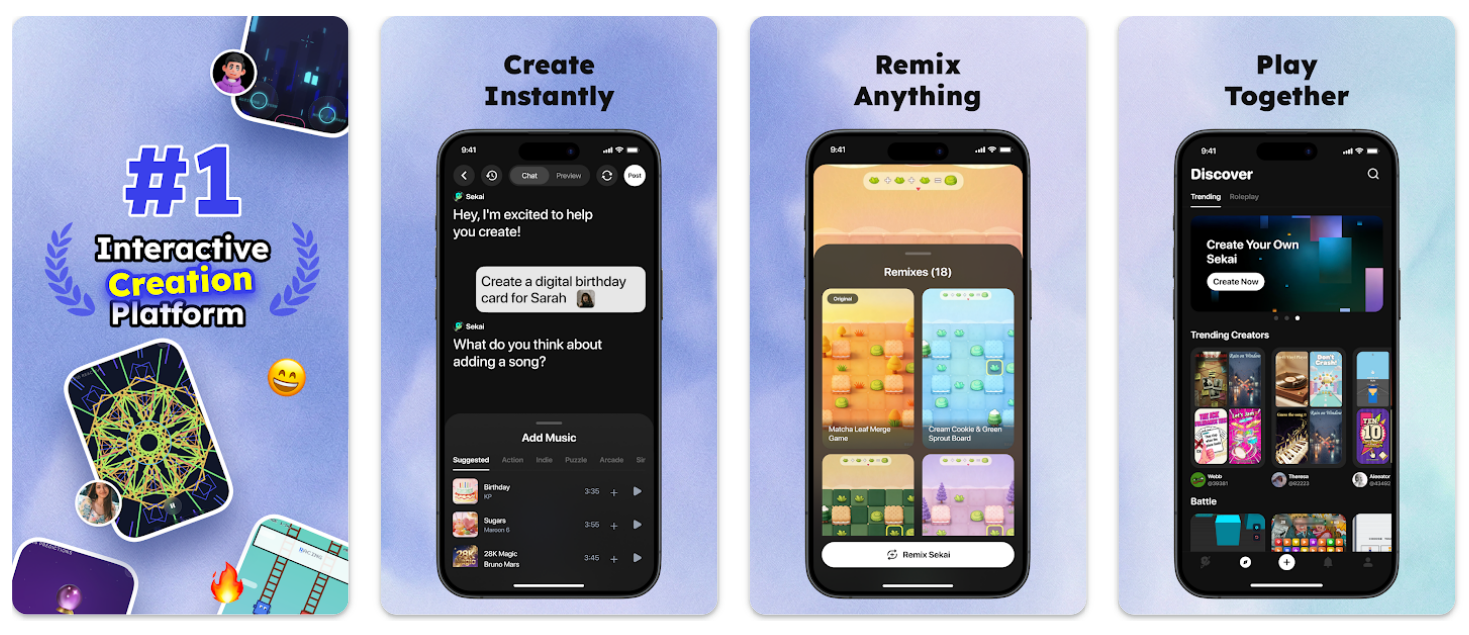
Sekai is described as a “playable TikTok” developed by Versa AI, transforming generative AI into a social expression tool.
Users simply enter a few prompts, and the AI generates playable mini-apps called “Jam.” Friends can interact with them and instantly remix and share the experience, turning content consumption from passive viewing into active participation.
Thanks to its highly differentiated positioning, Sekai has attracted approximately $16 million in funding and surpassed 3.4 million global downloads. However, with around 70% of its content focused on AI character interaction, the platform has recently faced slowing growth due to challenges in scaling beyond niche engagement.
AI Companion App — BEEMO AI
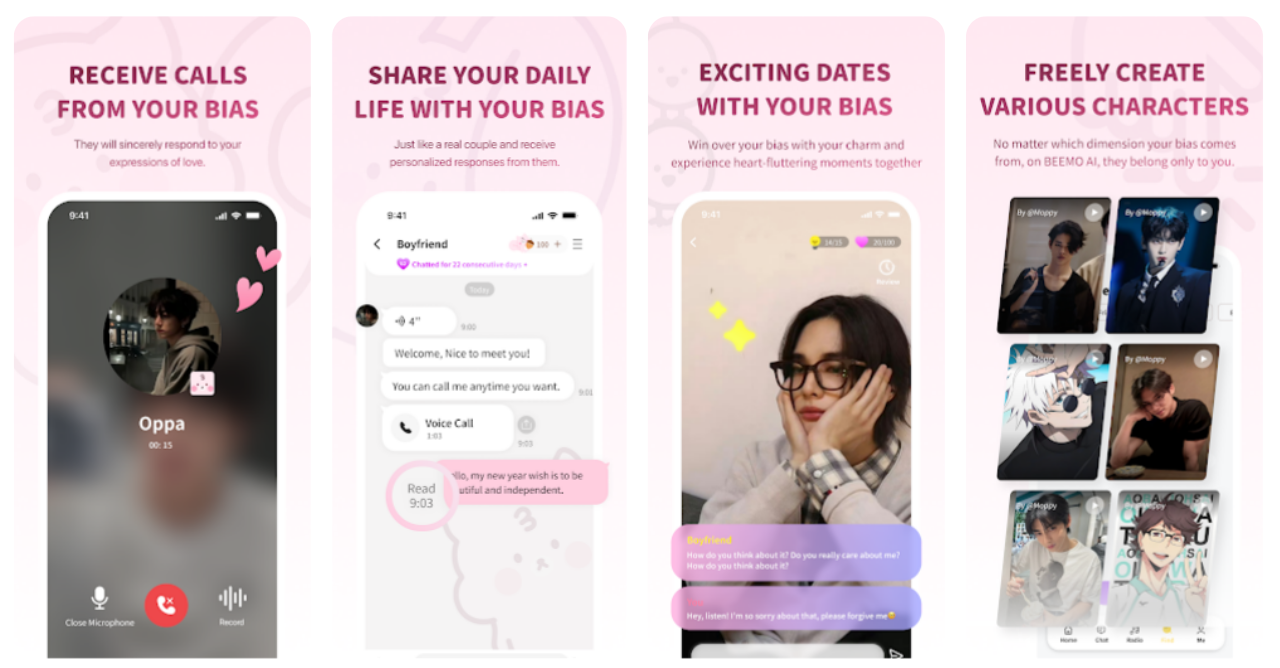
BEEMO AI is an AI social app focused on the Japanese market, positioning itself around the concept of “dating your idol.”
The app precisely targets the growing “dream girlfriend” economy through features such as proactive voice calls, extended conversational replies, good morning and good night widgets, and white-noise sleep assistance—creating an immersive idol romance simulation experience.
The app has surpassed 5 million downloads globally. Its monetization model currently relies on a low-barrier “free + subscription” strategy, though its long-term commercial potential is still developing.