

From Traffic Buying to Value-Driven Growth: How NetMarvel Helps Break Through in Mobile App Marketing


If the past decade of the global mobile app market was fueled by traffic dividends and rapid expansion, recent years have marked a clear shift into a “deep-water zone” of competition for existing users.
In this transitional phase, advertisers face dual structural challenges. On one hand, diminishing traffic dividends and increasingly fragmented user attention are driving up acquisition costs. On the other, tightening privacy regulations—such as Apple's App Tracking Transparency (ATT) framework—and fragmented cross-platform attribution are making precise targeting and performance measurement more difficult.
As the era of aggressive, large-scale user acquisition fades, how can advertisers achieve predictable growth in a high-barrier, high-volatility environment? Below, we break down the key shifts in mobile app marketing from market structure to regional and category dynamics, based on the latest data.
Ⅰ. Non-Gaming Apps Emerge as the New Growth Engine
Over the past year, the mobile app market has shown a clear divergence.
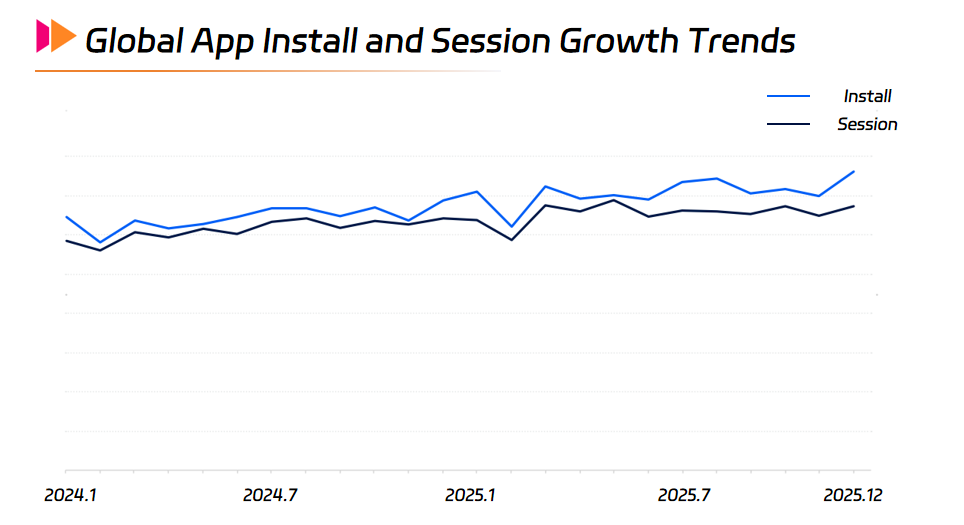
According to Adjust, global app installs grew by 10% YoY in 2025, while sessions increased by 7%. This growth was largely driven by non-gaming apps, whereas game downloads declined by over 5%.
Data Source: Adjust
This shift is also reflected in budget allocation. In 2025, global app user acquisition spend reached $78 billion, up 13% YoY—growth driven almost entirely by iOS. Notably, non-gaming apps became the core engine on iOS, with UA spend rising 18% to $53 billion.
Categories such as utilities, social, entertainment, and short drama apps are increasingly embedded in users' daily fragmented time. Compared to games—which require heavy development and longer cycles—non-gaming apps benefit from faster iteration and higher engagement frequency, positioning them as the new growth drivers.
Against this backdrop, advertisers are placing greater emphasis on both traffic quality and reach. By integrating diverse app scenarios and global traffic resources, NetMarvel enables advertisers to connect with users across gaming, social, and utility ecosystems—driving more efficient reach and conversion in fragmented environments.
Ⅱ. Retargeting Becomes Essential in a Saturated Market
As acquisition costs continue to rise, retargeting is shifting from an optional tactic to a strategic necessity.
In 2025, global retargeting spend reached $31.3 billion, up 37% YoY, showing explosive growth. iOS led this trend with a 71% increase, while Android grew by 10%. This reflects a growing recognition of user lifetime value (LTV): rather than competing solely on costly new user acquisition, advertisers are focusing on unlocking the long-term value of existing users.
In practice, retargeting delivers value in three key areas:
Re-engaging inactive users who haven't converted
Improving conversion efficiency by targeting high-value users
Extending lifecycle through personalized engagement
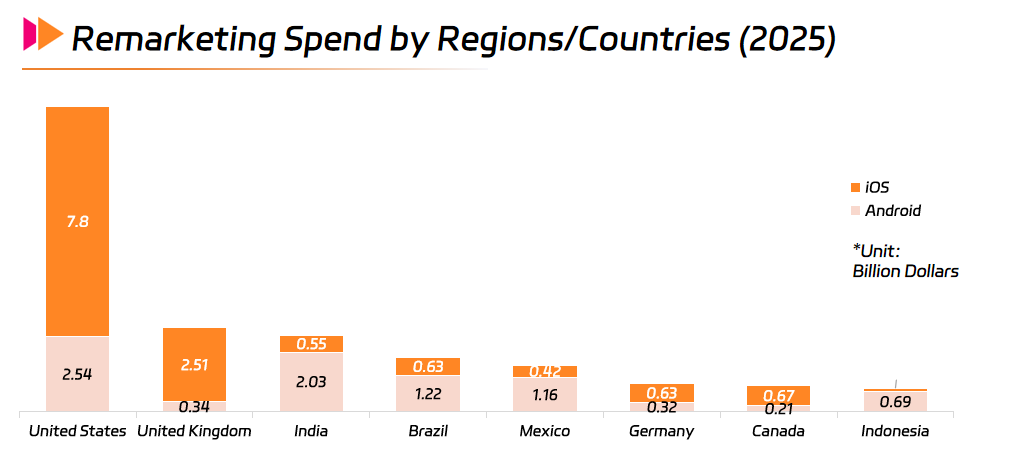
AppsFlyer data shows that retargeting investment correlates strongly with market competition. The U.S. leads with $10.34 billion, followed by the UK at $2.85 billion. Emerging markets such as India, Brazil, and Mexico are seeing the fastest growth.
Data Source: AppsFlyer
Ⅲ. iOS and Emerging Markets Drive Paid Activation Growth
As acquisition costs rise, paid activation is showing clear structural divergence, with iOS and emerging markets as key growth drivers.
From a platform perspective, iOS paid activations grew by over 25% YoY in 2025, while Android remained flat or declined in some segments. This indicates a shift of budgets toward high-value users, making iOS the primary channel for acquiring high-LTV audiences.
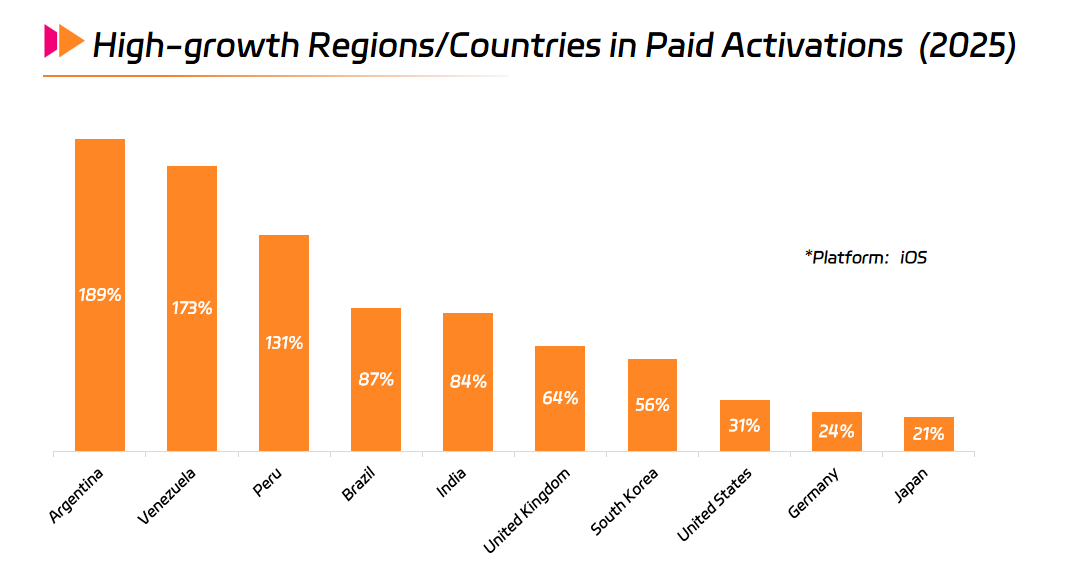
Regionally, emerging markets demonstrate stronger growth elasticity. Argentina (+189%), Venezuela (+173%), Peru (+131%), Brazil (+87%), and India (+84%) saw significant increases. Meanwhile, mature markets like the U.S. (+31%), Germany (+24%), and Japan (+21%) continue to deliver stable growth.
Emerging markets offer scalability, while mature markets provide consistent returns. As a result, advertisers are moving from single-point optimization to structured strategies—acquiring high-value users on iOS while unlocking growth in emerging regions.
Data Source: AppsFlyer
In this context, precision targeting and data-driven optimization are critical. Leveraging advanced algorithms and full-funnel capabilities, NetMarvel helps advertisers optimize across acquisition, conversion, and retention—maximizing performance across markets and platforms.
Ⅳ. Shopping Apps Show Strong Monetization Momentum
Among non-gaming categories, shopping apps are increasingly aggressive in marketing spend.
Global e-commerce app downloads grew from 4.36 billion in 2019 to 6.35 billion in 2025, a 45% increase. More notably, marketing investment surged: iOS ad spend for shopping apps rose 123% YoY, while Android grew 15%, with total spend exceeding $9.6 billion.
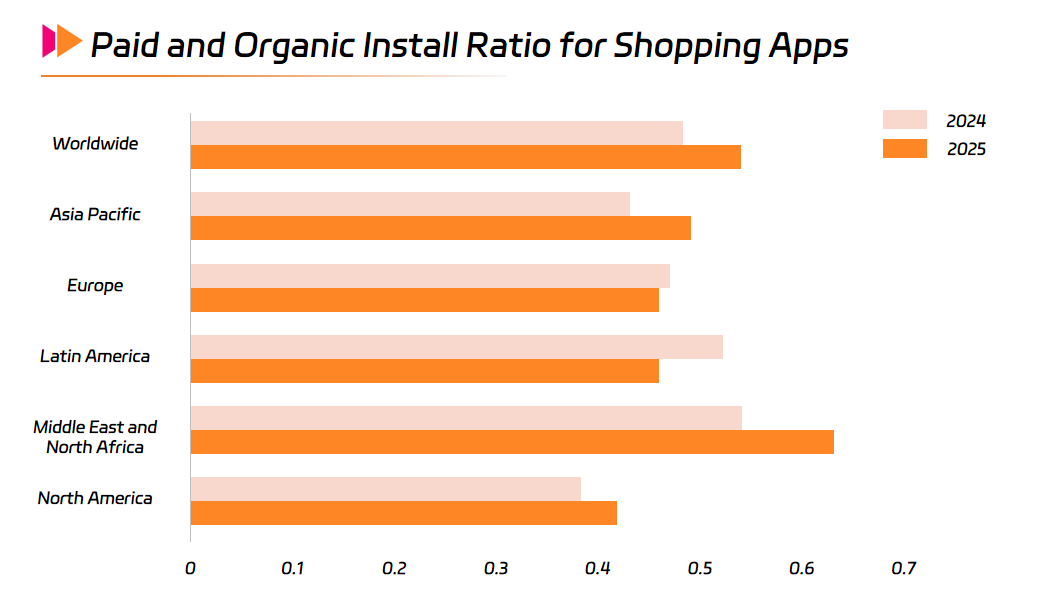
This growth is driven by the dominance of paid acquisition over organic installs. According to Adjust, the median paid-to-organic install ratio for e-commerce apps increased from 0.48 in 2024 to 0.54 in 2025, indicating a stronger reliance on paid channels.
Regionally, the most significant increases in paid installs were seen in MENA (+16%), APAC (+14%), and North America (+10%).
In an increasingly competitive e-commerce landscape, paid acquisition has become standard practice. Creative quality, campaign efficiency, and attribution accuracy now define competitive advantage.
Data Source: Adjust
Ⅴ. Entering the Era of Value-Driven Marketing
Looking back at the past year, four key shifts define mobile app marketing: the rise of non-gaming apps, the expansion of retargeting, the divergence in paid activation, and the rapid growth of e-commerce.
For advertisers, these are not just trends—they represent a fundamental shift in growth strategy. The focus is moving from download volume to user quality and LTV, from experience-based decisions to data-driven execution, and from single-channel acquisition to diversified, structured growth strategies.
As traffic dividends fade, competition is no longer about acquiring users—but about extracting value. Those who can better understand, reach, and continuously engage users will ultimately lead in the next phase of mobile marketing.