

The Rising “Silver Economy”: How Mobile Games Can Capture the Booming Senior Market?


If you still think that gaming is exclusively for younger people, it's time to rethink that perspective.
Today, the gaming industry is undergoing a significant shift in its user base. Gaming is no longer just for the younger generation, as an increasing number of middle-aged and senior adults are becoming involved. According to The Guardian, nearly 60% of adults aged 45 to 54 in the UK have played video games, a significant increase from 43% in 2013.
In response to this new trend, many developers have already started targeting this demographic, with notable success. Data from Sensor Tower shows that Vita Studio's Mahjong-themed puzzle game, Vita Mahjong, aimed at users aged 55 and older, has accumulated over 200 million downloads globally, proving the huge market potential of senior players.
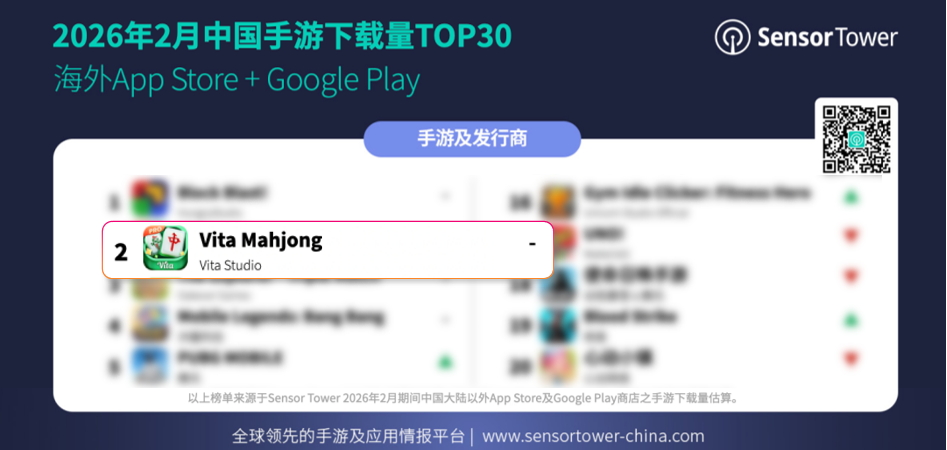
Vita Mahjoing ranked second on the February mobile game download chart. Source: Sensor Tower
However, middle-aged and senior players have different media habits, payment behaviors, and emotional needs compared to younger generations, so a simple transplant of strategies is bound to fail. As this multi-billion-dollar market continues to grow, how can mobile game developers and advertisers systematically tap into the senior player segment, seize opportunities, and achieve sustained growth?
1. Growing Demand for Games Among Middle-aged and Senior Players
With the global population aging, middle-aged and senior adults have become an increasingly important consumer group across various industries.
In the U.S., seniors make up nearly one-third of all gamers, with 57 million players aged 50 and older. According to NPD, the gaming spending of middle-aged and senior adults continues to rise. Specifically, the time spent on games by Americans aged 45 to 54 has increased by 59%, while the figures for those aged 55 to 64 and 65+ grew by 48% and 45%, respectively.
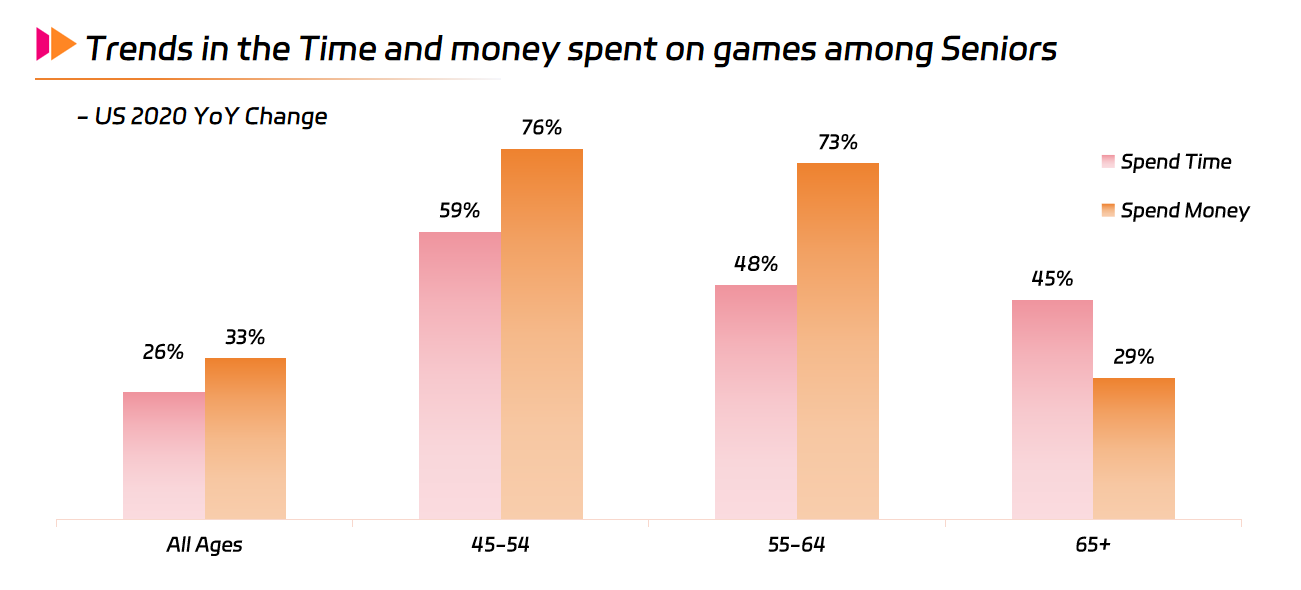 Source: Marketing Charts
In addition to the increased time spent gaming, there has also been a significant rise in spending. Adults aged 45 to 54 (76% increase) and 55 to 64 (73% increase) have shown much faster spending growth than other age groups. Even those aged 65 and older have seen a 29% increase in gaming expenditure. These figures show that senior players not only spend more time gaming but also present a significant potential for spending.
Why are more and more seniors getting involved in gaming?
Surveys indicate that 79% of middle-aged and senior players say games help pass the time, 68% believe they provide brain exercise, and nearly half play for entertainment. Additionally, 57% of senior players believe games help them make new friends or establish new social connections. As a result, gaming is gradually becoming a major form of recreation for them.
In terms of game genres, middle-aged and senior players show distinct preferences compared to younger players. They tend to favor simple, low-stress games. Puzzle games, social games, and card games have become the top choices for this group.
Tammenkoski, CEO of Merge Mansion, points out: “In the casual game sector, we found that players aged 45 and older are driving growth and revenue, but their interest in discovering new games is lower. Casual game players used to be women over 35, but now we have players in their 70s, which is no surprise as the audience for casual games continues to expand.”
2. Case Study: Emphasizing “Mild Competition” and “Social Connection” Attributes
Senior players are not a homogeneous group; there are varying demands within the demographic. However, there are common preferences in their gaming habits — they seek low cognitive load and high emotional return. As a result, developers targeting this group often emphasize mild competition and social connection in game design.
In this context, Vita Mahjong is undoubtedly a successful example.
This game isn't a traditional Mahjong game; it's a matching puzzle game based on the Mahjong theme. By simplifying the rules and reducing the difficulty, it alleviates the cognitive load for overseas users unfamiliar with traditional Mahjong. Additionally, the game features a relaxing pace, avoiding overly tense time limits and complicated operations. It also offers daily challenges and level-based challenges, meeting the dual demands of senior players for both relaxation and brain exercise.
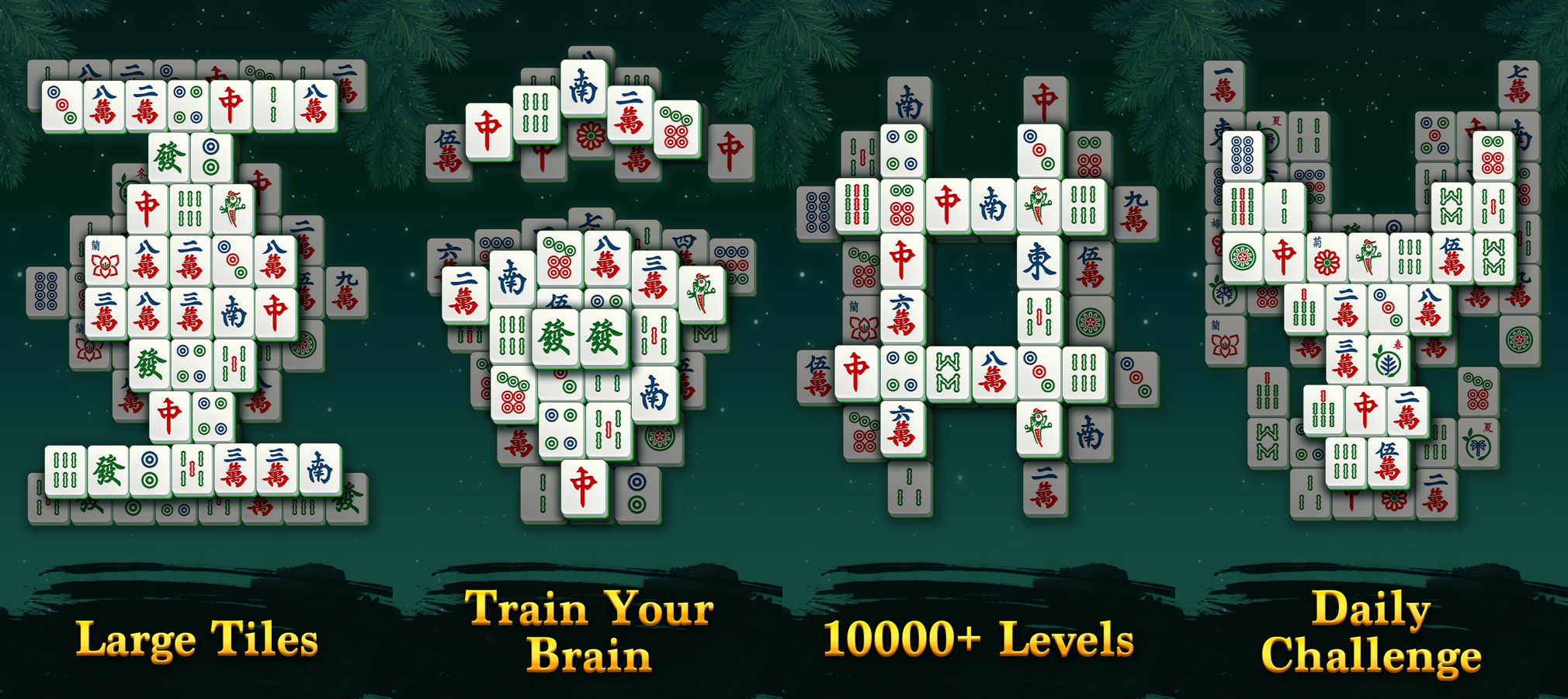
What's notable is that Vita Studio, the developer behind Vita Mahjong, has been focusing on the senior market for many years. All the games developed by Vita Studio are labeled with the “Vita” prefix and “for Seniors” suffix, clearly targeting the senior player demographic. The games cover various casual genres like solitaire, puzzles, and coloring.

Another game, Gossip Harbor, takes a different approach — its “senior-friendly” design expands the senior player group.
As a vertical casual game developed by Lemon Micro Fun, Gossip Harbor targets middle-aged housewives aged 35 and older. It uses a minimalist one-handed vertical screen mode for easy gameplay and reduces complexity. The game also features a relaxed pace, making it suitable for fragmented playtime, with no forced online requirement or excessive progress pressure, catering to the leisure needs of senior players.

What's more important is that the storyline of Gossip Harbor focuses on family relationships and interpersonal conflicts, resonating with middle-aged and senior players. This emotionally-driven design allows the game to provide deep emotional resonance while offering entertainment, successfully attracting a large number of senior players.
3. Marketing Materials: Using “Simple Tactics” to Appeal to Senior Players
In terms of user acquisition for senior players, advertisers have developed a standard approach — the core logic is “straightforward adaptation and emotional resonance.”
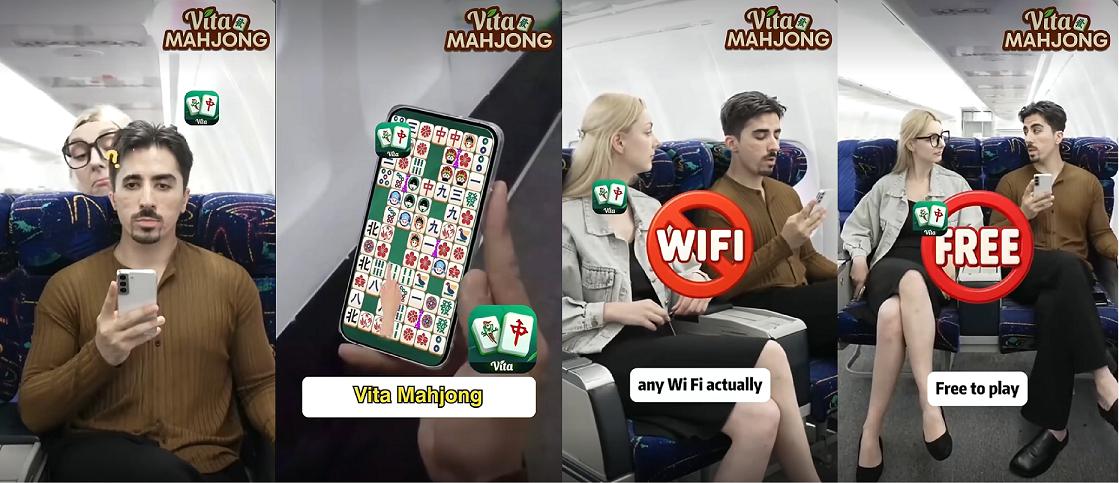
Senior players are less receptive to flashy promotions, so marketing materials tend to focus on “easy operation, low pressure, and value,” using simple and direct presentations to alleviate any concerns about trying the game. For example, Vita Mahjong’s ads highlight features like “no WIFI” and “Free to play,” emphasizing the game’s accessibility and eliminating worries about technical complexity, while this straightforward approach increases the ad’s relatability and encourages users to give it a try.
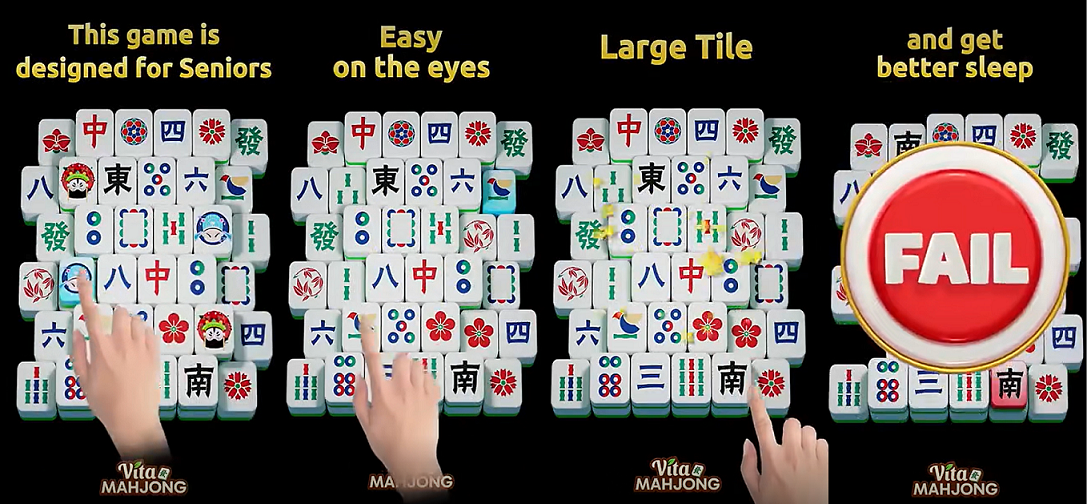
Additionally, ad content must emphasize emotional appeal, aligning with the emotional needs of senior players. Through warm, comforting scenes and emotionally resonant copy, ads can spark connections with potential users.
Moreover, emphasizing the easygoing gameplay and quick sense of accomplishment in the game is a key element to attract senior players. Marketing materials often focus on level progression and achievement displays, highlighting the game’s relaxing and time-killing functions to improve ad accuracy and attractiveness.
4. Conclusion
With the acceleration of global aging, senior players are emerging as a key growth segment in the mobile gaming market.
Unlike younger users, this group is driven by “passing the time, exercising the brain, and social connections” and prefers low-barrier, high-emotional return casual games. To capture this multi-billion-dollar blue ocean, developers need to abandon simplistic “youth-oriented transplant” strategies and instead conduct systematic “senior-friendly” adaptations in both product design and marketing strategies — simplifying operations, relaxing the pace to reduce cognitive load, while building trust and connection through emotional resonance and clear communication.
In short, only those who truly understand and respect the unique logic of senior players can turn the “demographic dividend” into a sustainable growth engine.