

From Buying Traffic to Winning Value: The New Mobile Gaming Playbook


Looking back at the first half of 2026, the global mobile gaming market continued to operate in an increasingly mature, highly competitive environment, with structural shifts becoming more pronounced.
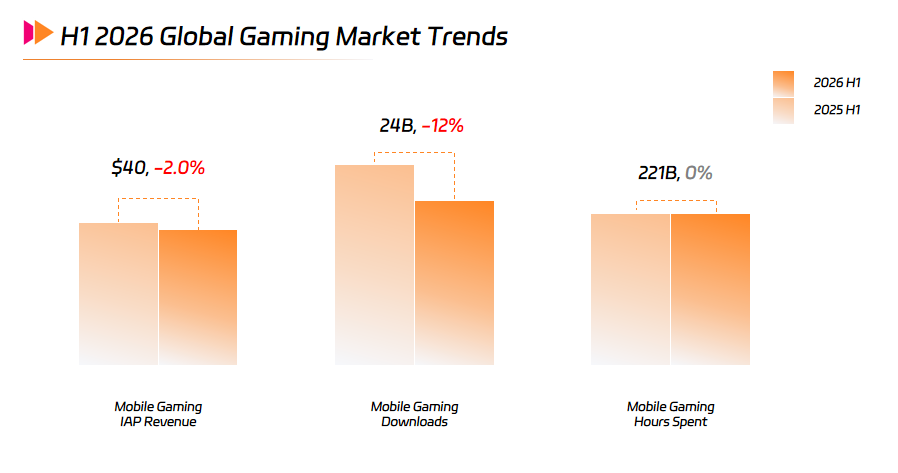
According to Sensor Tower, global mobile game IAP revenue declined slightly by 2% year over year in H1 2026. Total downloads fell 12% YoY, while total player time spent remained broadly flat compared with the same period last year. In other words, the market has not experienced a significant loss of user attention. The real challenge is that acquiring new users is becoming increasingly difficult, while competition for the value of existing users is intensifying.
As “higher acquisition costs and more expensive retention” become the new normal, how can game developers optimize their strategies across genres, creatives, channels, and other dimensions? In this article, we analyze the latest market data to uncover growth opportunities in the global mobile gaming market.
1. Downloads Decline as Competition for Existing Users Intensifies
In H1 2026, global mobile game IAP revenue reached $40 billion, down slightly by 2% YoY. Total player time spent remained stable at 221 billion hours, while global downloads dropped sharply by 12% YoY to 24 billion.
Data source: Sensor Tower
Looking at major game genres, the global mobile gaming market is becoming increasingly polarized:
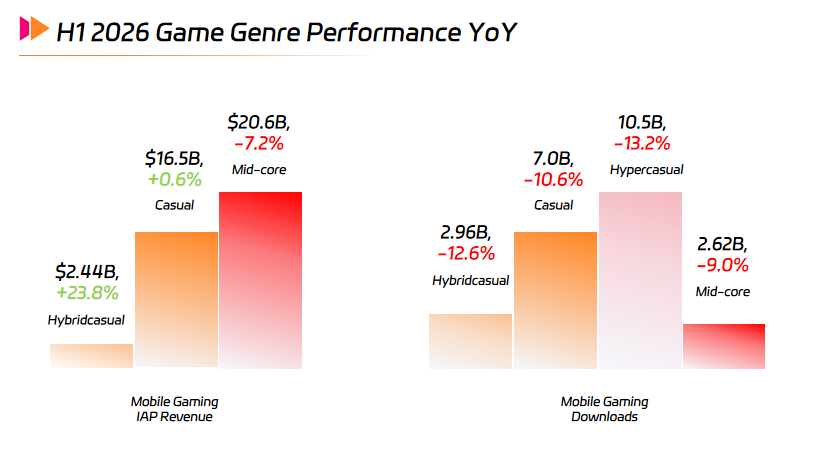
- The mass-market traffic dividend for hypercasual games is fading: Hypercasual downloads plunged 13.2% YoY. Markets such as India, Brazil, and Indonesia each saw tens of millions fewer downloads, making them major contributors to the overall decline in downloads.
Hybrid-casual is emerging as a strong growth engine: The boundaries between mid-core and casual games are becoming increasingly blurred. While traditional mid-core titles continue to lose market share, hybrid-casual games, which combine accessible core gameplay with deeper, long-term monetization mechanics, have emerged as the only segment delivering strong growth. IAP revenue increased 23.8% YoY in H1.
Data source: Sensor Tower
For advertisers, simply “generating more installs” used to be a growth objective in itself. Today, however, the value of pursuing install volume alone is declining. In mature markets especially, users are already heavily occupied by leading titles. To capture attention, new games need not only larger user acquisition budgets, but also stronger product differentiation and more compelling content.
2. Genre Polarization: Declining Segments and Emerging Opportunities
The mobile gaming market in H1 2026 was not simply contracting across the board. Instead, it showed clear structural differentiation across genres.
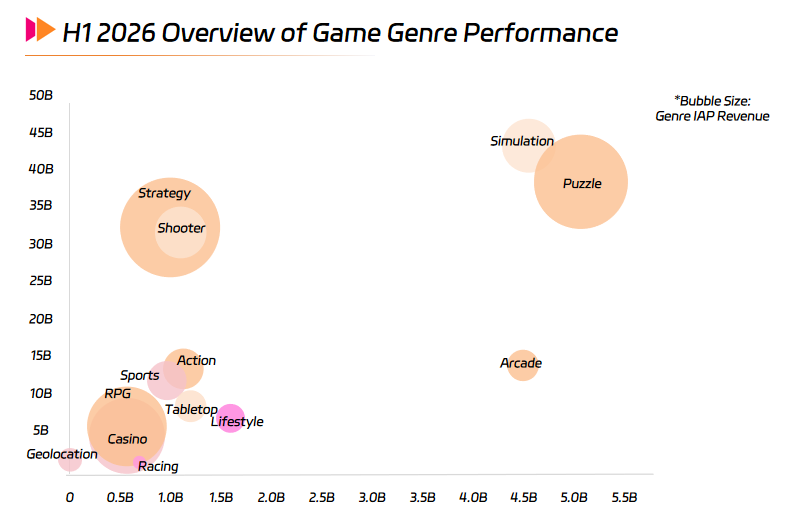
According to Sensor Tower, Strategy remained the highest-grossing mobile game genre by IAP revenue, reaching $9.3 billion in H1. Puzzle ranked second at $8.1 billion, followed by RPG at $6.1 billion and Casino at $5.0 billion. Notably, Puzzle IAP revenue increased by nearly 20% YoY, while Strategy declined by approximately 5%. The revenue gap between the two genres narrowed from around $3 billion previously to just $1.2 billion.
More importantly, game scale and monetization efficiency are becoming increasingly disconnected. Puzzle, Simulation, and Arcade games each generated more than 4.5 billion downloads, but their IAP performance did not fully correspond to their download volumes. Arcade games, in particular, generated significantly less revenue than the other two genres despite their large user base. Meanwhile, genres such as Strategy, RPG, and Casino were able to generate higher revenues from relatively smaller user bases.
Data source: Sensor Tower
This reflects a broader shift in the mobile gaming market—from competition for traffic volume to competition for user value. A game with a massive base of low-value users is not necessarily more commercially valuable than one with a smaller but highly monetizable audience.
For UA strategies, this means advertisers can no longer rely on the simple logic that “high downloads = worth investing in.” Instead, they need to evaluate user scale, spending power, ad monetization potential, retention curves, and user acquisition costs together to determine whether a genre truly supports a sustainable monetization model.
3. Intensifying Ad Competition Keeps UA Investment High
More new advertisers are entering the market, while established players are increasing their investment.
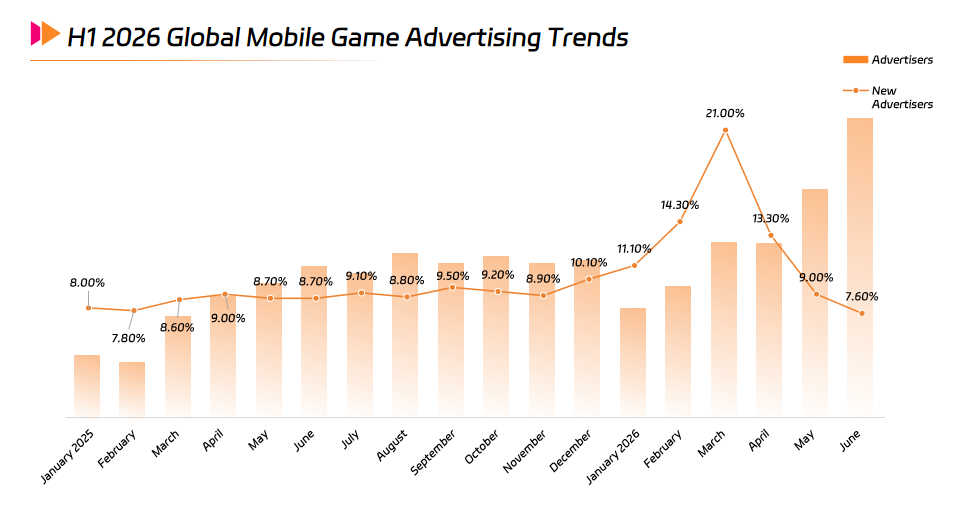
In H1 2026, global mobile game advertising continued to expand, with an average of 109,500 active advertisers per month, up 31.1% YoY. The share of ad spend from new advertisers peaked at 21.0% in March, before steadily declining to 7.6% over the following months. This suggests that the growth from new advertisers was concentrated primarily in Q1, while Q2 increasingly shifted toward existing advertisers scaling up their campaigns.
Data source: SocialPeta
By channel, in-app advertising remained the core traffic source for mobile game advertising.
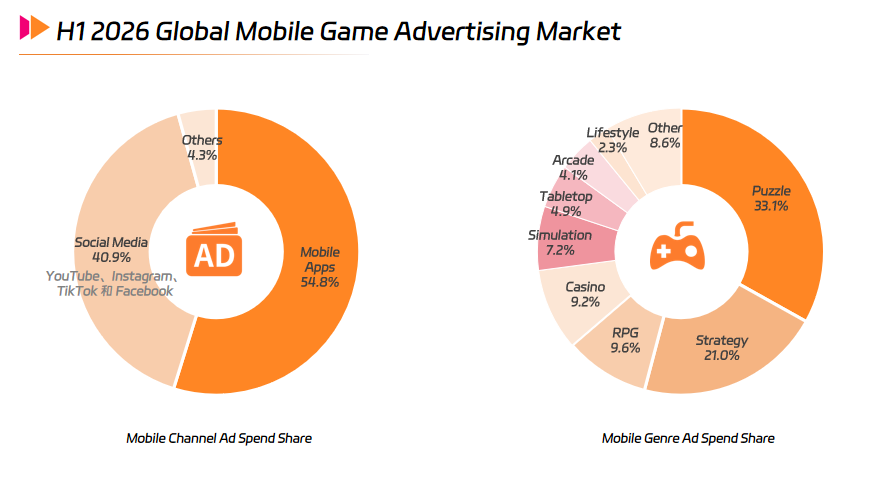
In H1 2026, mobile apps accounted for 54.8% of total global mobile game ad spend, significantly higher than the 40.9% combined share of leading social media platforms including YouTube, Instagram, TikTok, and Facebook. For game advertisers, social media is not replacing in-app inventory. Instead, the two channels complement each other by reaching users at different touchpoints, from content consumption to in-game environments.
By genre, Puzzle and Strategy accounted for 33.1% and 21.0% of mobile game advertising respectively, together representing more than half of total ad activity.
Data source: Sensor Tower
Overall, mobile apps remain the primary battleground for scaling mobile game user acquisition, while social media has become an important incremental channel. As the number of advertisers continues to rise and competition intensifies, the future of UA will depend not simply on expanding traffic reach, but on improving acquisition efficiency and user value through precise audience targeting, creative optimization, and cross-channel coordination.
4. From Acquisition to Retention: Unlocking High-Value Users
Against the backdrop of an increasingly mature market, mobile game advertisers need to move beyond simply “buying installs” and build a growth loop around the entire user lifecycle.
Through the aggregation of massive volumes of premium owned and external traffic, NetMarvel provides game advertisers with scalable UA capabilities across diverse app environments, including mobile games, social apps, and utility apps. By combining audience signals such as user behavior, interests, and conversion performance, NetMarvel helps advertisers move beyond “acquiring more users” toward “acquiring higher-value users.”
Beyond user acquisition, retargeting is becoming a critical lever for unlocking the value of existing users. NetMarvel segments installed, active, churned, and high-potential users based on behavioral and conversion data, then engages different audience segments at different stages of the user lifecycle to drive reactivation, engagement, and monetization.
NetMarvel also helps advertisers extend beyond mobile through CTV advertising, tapping into high-attention audiences across premium living-room environments, including home entertainment, sports, and long-form video. Across major short-form video and social media channels, NetMarvel integrates short-form video, KOC/UGC, and native content marketing into the acquisition ecosystem to drive compounding, sustainable growth.
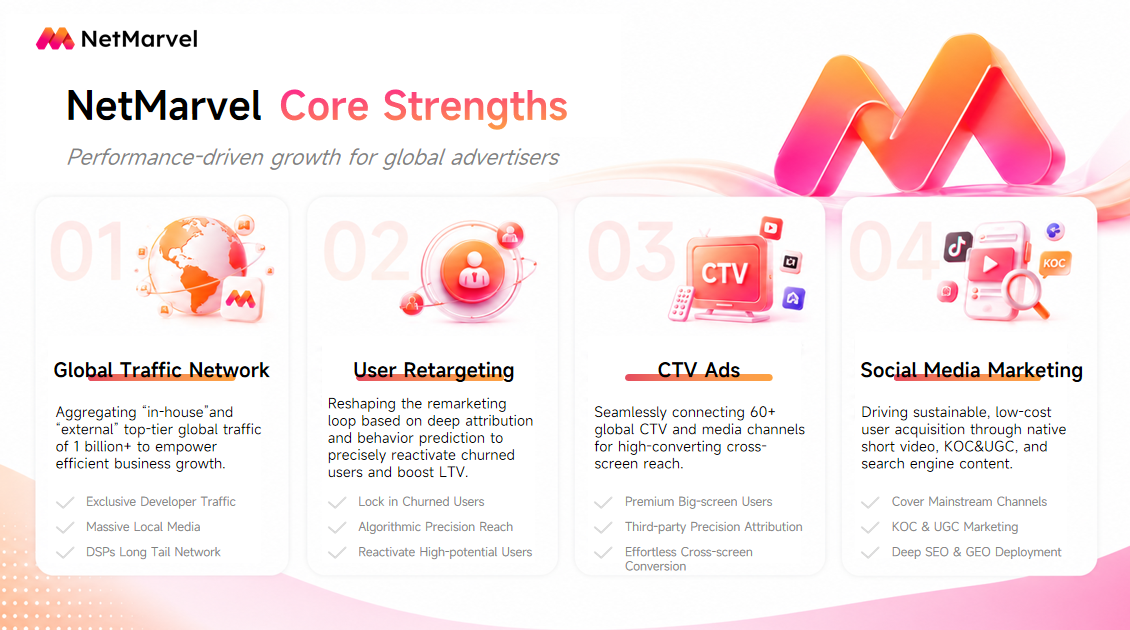
From UA to retargeting, from mobile apps to CTV, and from performance media to content-driven engagement, NetMarvel helps advertisers build a full-funnel growth ecosystem spanning acquisition, activation, reactivation, and conversion—shifting advertising investment from simply maximizing traffic volume to maximizing long-term user value.