

Beyond the Download Slump: Strategies to Win the 2026 Global Mobile Game Market


The global mobile gaming market is entering a critical phase of structural divergence.
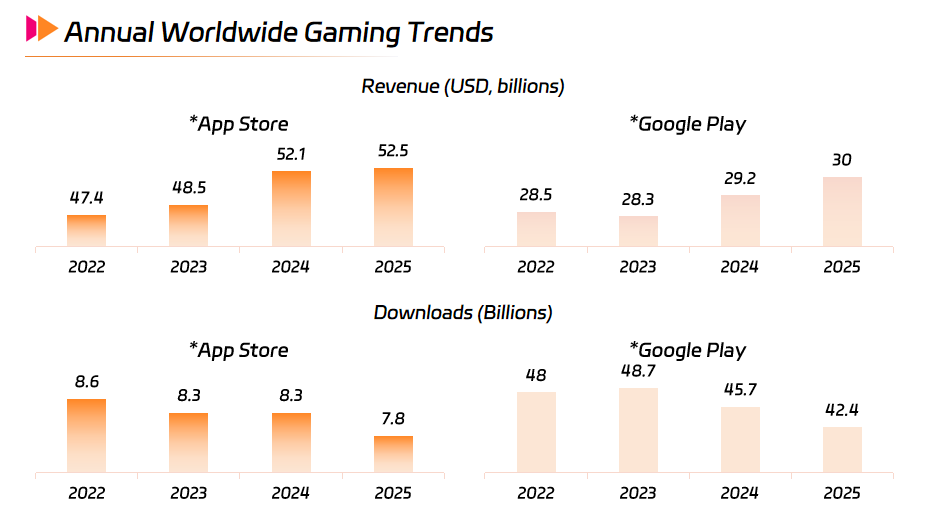
Data shows that in 2025, global mobile game downloads declined by 7.0% year-over-year, signaling mounting pressure on user growth. At the same time, in-app purchase (IAP) revenue grew by 1.4% YoY, reaching $82 billion. While new user growth is slowing, the monetization potential of existing core players continues to expand.
On the supply side, competition is intensifying. Over 205,000 new games were launched throughout the year—equivalent to one new game every 2.5 minutes—further increasing market density.
Amid the dual pressure of declining downloads and surging new releases, is the traditional “paid acquisition” model losing effectiveness? How can mobile games find a balance between high-frequency launches and long-term retention? Based on the latest Sensor Tower report, this article explores key strategies for breaking through in 2026.
I. Market Size: Efficiency Over Scale
In 2025, the global mobile game market demonstrated a clear trend of “shrinking volume, improving efficiency,” with total downloads exceeding 50 billion.
From a channel perspective, Google Play held 84.5% of the market share, but its downloads declined by 7.3% YoY—steeper than the App Store's 5.7% drop. Slowing user growth has become an industry consensus.
Data Source: Sensor Tower
However, both platforms showed strong resilience in IAP revenue. The App Store saw a slight increase of 0.6% to $52.5 billion, while Google Play achieved a 2.8% increase to $30 billion despite declining downloads.
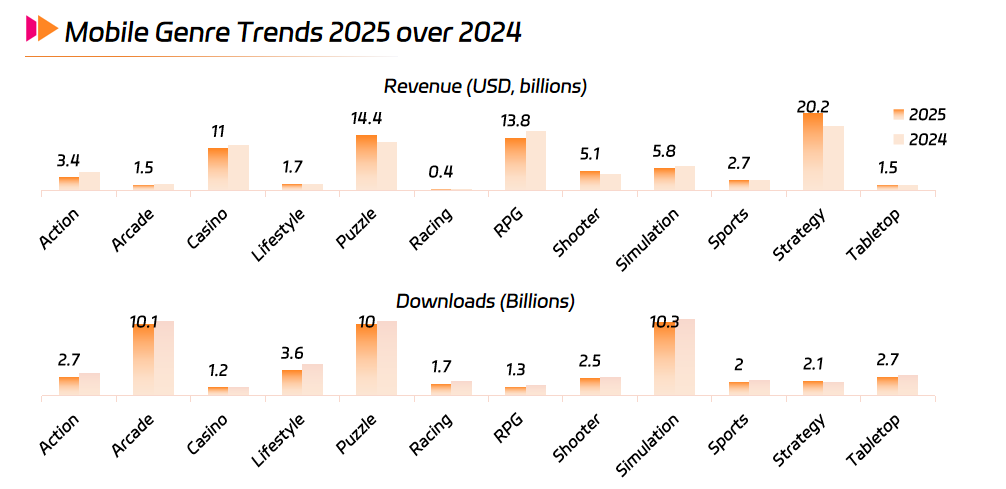
Game category dynamics are also diverging rapidly, with strategy and puzzle games emerging as key growth drivers.
Strategy games led with a 20% increase in IAP revenue and were the only category to achieve download growth. This surge is driven by mature gameplay and monetization models. Titles like Last War: Survival and Whiteout Survival successfully broke genre limitations by integrating casual sub-gameplay with high daily engagement.
Puzzle games followed with a 14% revenue increase, demonstrating strong monetization resilience through long-term operations. In contrast, traditional genres such as RPG and simulation faced pressure in both downloads and revenue, as user preferences shift toward “deep strategy” and “light, high-frequency experiences.”
Data Source: Sensor Tower
II. User Profiles and Monetization Trends
User demographics vary significantly across game categories.
In the U.S., mid-core and hardcore players are concentrated in the 18–34 age group (nearly 67%), especially among 25–34-year-olds who have stronger spending power and long-term engagement. Casual and hyper-casual games, however, show a more balanced age distribution, with higher penetration among users aged 35+, indicating expansion into broader and even older demographics.
From a gender perspective, mid-core and hardcore games remain male-dominated (69.1%), while casual and hyper-casual games skew female (58.1% and 67.1%, respectively), making women the primary growth drivers in these segments.
Data Source: Sensor Tower
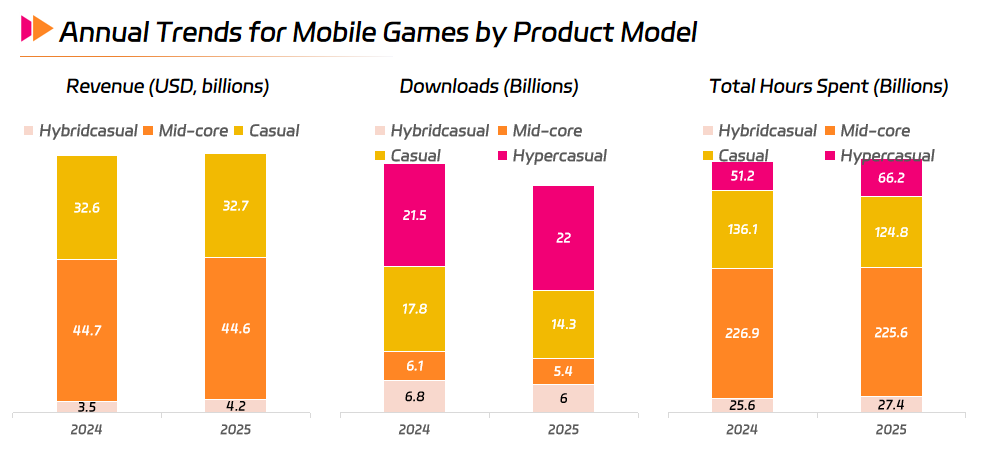
In 2025, hybrid casual games became the fastest-growing monetization model, with revenue rising 20% YoY to $4.2 billion, while traditional casual and mid-core games remained relatively stable.
On the download side, most categories declined, except hyper-casual games, which grew by 2% to 22 billion downloads, maintaining their role as a key traffic entry point.
User engagement trends further highlight this shift. Time spent in hyper-casual games increased by 29% YoY, particularly in mature markets like the U.S., Japan, and Western Europe. Games like Block Blast! and Mahjong Vita achieved both strong acquisition and retention through compelling hooks and short gameplay loops—an approach increasingly adopted across categories.
Data Source: Sensor Tower
While casual and mid-core games still dominate IAP revenue, hybrid monetization is becoming the most viable path for non-top publishers. However, as competition intensifies, success will depend on maximizing monetization efficiency per unit of user attention.
III. Advertising and Marketing Trends
From a channel perspective, mobile game advertising shows a pattern of “stability with gradual shifts.”
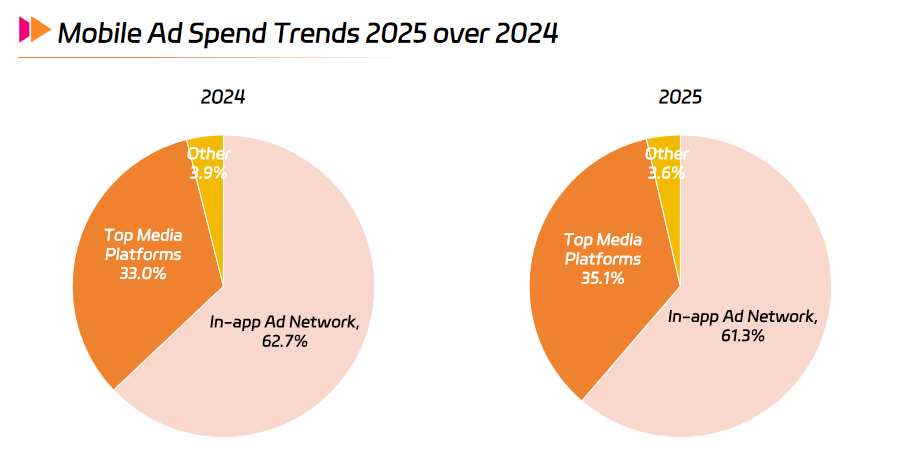
In 2025, mobile ad networks remained dominant with a 61.3% share, despite a slight decline. Their broad reach and high-quality traffic continue to make them the core channel for performance-driven campaigns. Meanwhile, top social media platforms increased their share from 33.0% to 35.1%, with video platforms like YouTube driving growth.
This shift reflects an evolution in advertiser strategy—from purely download-driven campaigns to more holistic approaches that prioritize retention, monetization, and high-value user acquisition. Content quality and precision targeting are becoming increasingly critical.
Data Source: Sensor Tower
In terms of efficiency, casual games still face intense competition in paid acquisition despite lower IAP contribution.
In the U.S., lifestyle and puzzle games accounted for 56.2% of ad spend but only 41.3% of revenue, indicating heavy saturation. In contrast, casino games demonstrated high monetization leverage, generating 21.6% of revenue with just 10.4% of ad spend. Mid-core genres such as action and strategy showed more balanced growth models.
A similar pattern is observed in Japan, where casual games face cost-revenue imbalance, while mid-core games achieve higher ROI.
Data Source: Sensor Tower
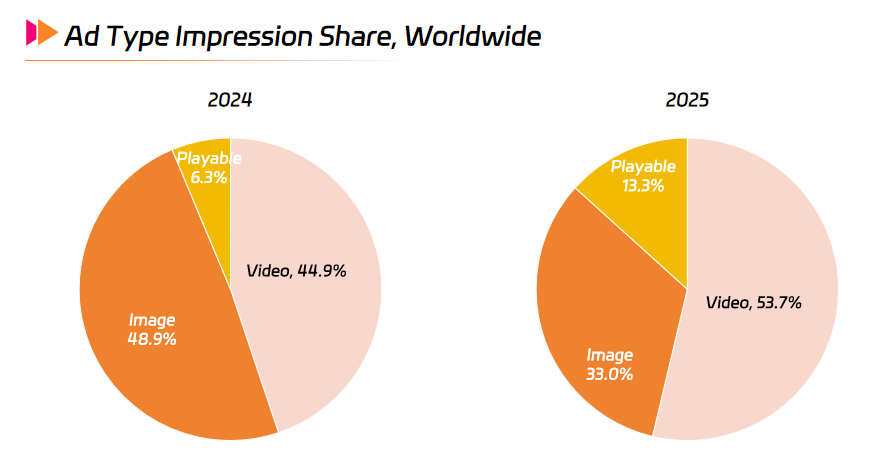
Ad formats are also evolving toward content-driven and video-first strategies. In 2025, video ads accounted for 53.7% of total ad formats, becoming the dominant form, while image ads dropped sharply to 33.0%. Traditional static creatives are losing effectiveness.
Playable ads nearly doubled their share from 6.3% to 13.3%, reflecting growing demand for interactive experiences. Overall, advertising is shifting from “display-driven” to a combination of content and experience, improving user quality and conversion efficiency.
IV. Conclusion
As the “download dividend” fades, the mobile gaming market is shifting from traffic acquisition to value extraction.
Whether through gameplay innovation or channel optimization, the underlying goal remains the same: rebuilding growth certainty in a saturated market.
Looking ahead, success will depend on two core capabilities: the ability to precisely identify high-value users, and the discipline to maximize their lifetime value (LTV).
The era of extensive growth is over—refined, data-driven operations are now the key to sustainable success.